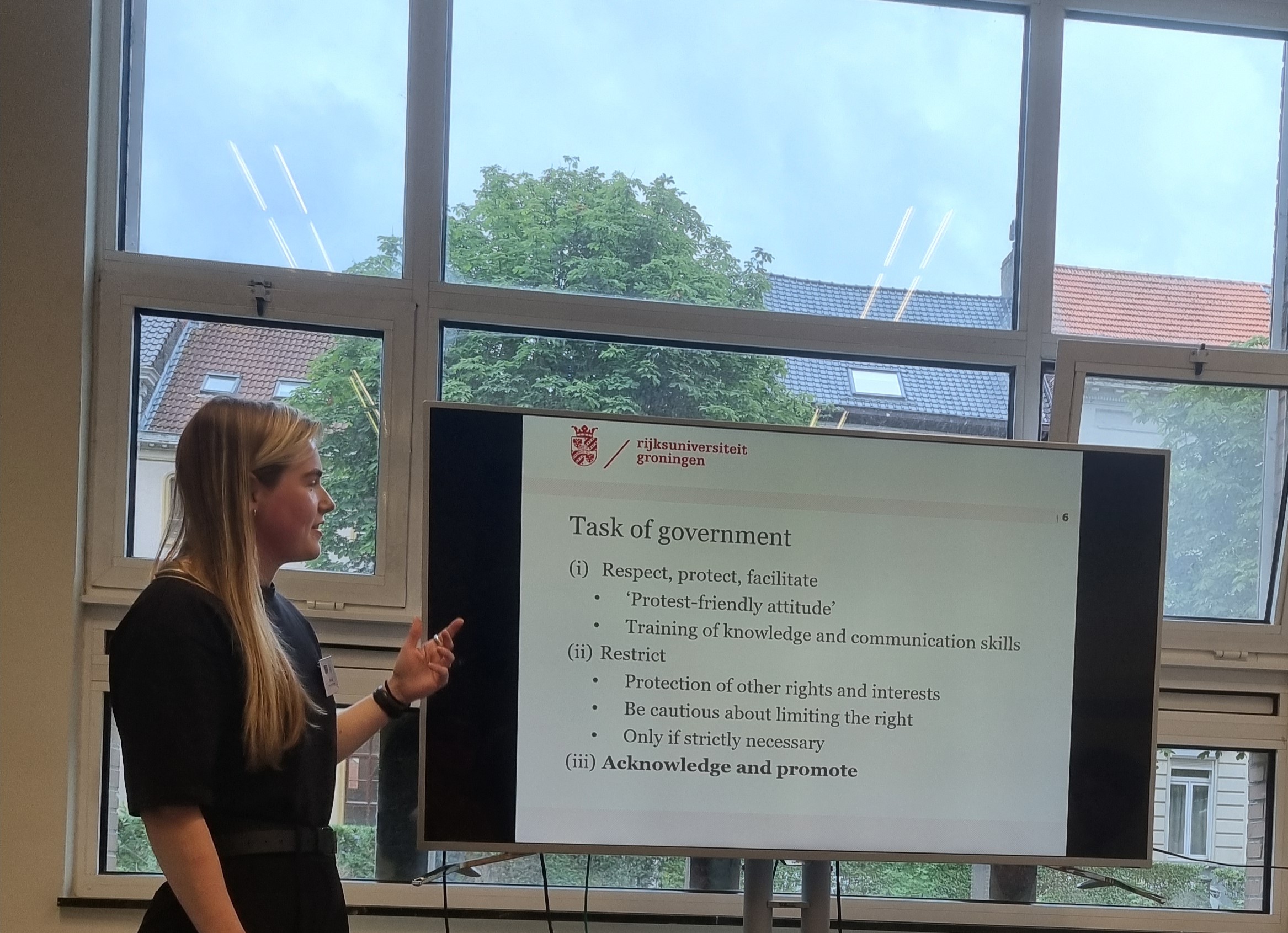
Credits: Noor Swart
This post is based on the author’s presentation at the Annual Political Science Workshops of the Low Countries (the Politicologenetmaal), organised at Ghent University on the 11th and 12th of June 2026. The author’s attendance at the (non-legal) conference was supported by the NNHRR Conference Attendance Grant scheme.
Civil society faces increasing pressure in Western Europe. This is not only visible in the direct criminalisation of civil society organisations and the cuts in their funding, but also in restrictions that are placed on human rights that protect civil space, such as the right to freedom of peaceful assembly as laid down in Articles 11 ECHR and 21 ICCPR. In the Netherlands, for instance, proposals to restrict the right to freedom of peaceful assembly have been put forward for the first time since the enactment of the Public Assemblies Act in 1989. The Dutch Minister for Justice intends to – among others – introduce a ban on face coverings during demonstrations. The proposal has attracted a lot of criticism; it would mark a substantial restriction on the freedom to protest anonymously, possibly deterring civil society activists to take to the streets.
Restrictions on the right to freedom of peaceful assembly go hand in hand with a more negative attitude towards demonstrations. Demonstrations are increasingly framed as a threat to public order rather than as a legitimate democratic activity, as is also pointed out by the UN Special Rapporteur on the rights to freedom of peaceful assembly and of association.
In the Dutch public debate, a frequently heard argument is that many demonstrations lead to disturbances of the peace or even result in violence or riots. However, most demonstrations seem to proceed without any issues. In fact, in May 2025, the Inspectorate of Justice and Security of the Ministry of Justice and Security concluded that 97% of all demonstrations do not pose a risk to public order and safety. Of the remaining 3% in which incidents did occur between 2015 and 2022, three-quarters of the cases involved a single incident being recorded. It is important to emphasise this, because the image portrayed in debates on the right to freedom of peaceful assembly greatly influences the wider perception of demonstrations.
Demonstrations perform important functions within a democratic society. They, among others, enable political participation, give voice to minority groups, and serve as both a warning mechanism and some sort of ‘safety valve’ for societal grievances. Protesting is also a crucial means by which people can get together and create an open forum, a sense of solidarity and (political) belonging where civil society can flourish. Essentially, demonstrations contribute to shaping and maintaining a democracy, because they give the opportunity to challenge power and offer protection against it, put topics on the (political) agenda and create space for a diverse, inclusive society. As the UN Human Rights Committee (HRC) points out in General Comment 37, protests also help recognise and realise a wide range of other rights, such as the right to vote. Failure to respect and ensure this fundamental right is typically a marker of repression, the HRC observes.
Thus, the level of protection afforded to the right to freedom of peaceful assembly is closely related to the state of a democracy. Protecting democracy implies protecting and thus giving space to (contentious) protest. Given the current negative attitudes that surround the right to freedom of peaceful assembly, the stigmatisation and pressure that protesters increasingly face, but also given the worldwide closure of civil space, it is therefore time to foster a more positive approach to this fundamental right.
Such a positive approach should be clearly reflected in the authorities’ method of regulating protest. Authorities primarily have a duty to respect, protect and facilitate protest. This requires, among others, a protest-friendly attitude during all stages of a protest: before, during and after the planned or spontaneous demonstration. Such an attitude not only entails that authorities respect the limits of the law and clearly motivate decisions that do restrict the right to protest. It also means that authorities – as protectors of the democratic sphere – proactively make public spaces for protest safely accessible and acceptable for controversial speech. As pointed out by (among others) the UN Special Rapporteur on the rights of freedom of peaceful assembly and of association, law enforcement officials should know how to communicate and build relationships with protesters and have sufficient knowledge of the right to protest. Knowledge of this right should, however, be disseminated more widely, so that a broader comprehension of why the right to freedom of peaceful assembly has been given such a broad scope within our democratic society can be attained. The protection the right to protest ultimately requires a widely shared understanding of its functions.
Crucially - as is prescribed by Articles 11(2) ECHR and 21 ICCPR - authorities should only restrict the right to freedom of peaceful assembly when such a restriction is strictly necessary. In practice, this necessity requirement is essential when evaluating restrictions to the right to freedom of peaceful assembly. When we for instance consider the Dutch ban on face coverings during demonstrations, existing powers already give sufficient possibilities to local authorities to restrict face coverings when necessary in specific cases - something that the local authorities themselves have repeatedly pointed out. Introducing a ban would therefore go further than is strictly necessary to protect the rights of others.
Looking at the broader picture, it is important to keep in mind that the protection of other rights and interests can exist besides the acknowledgement and promotion of the right to protest. It is a right that can cause tension, that literally takes up (public) space. Yet, it is also a right that guarantees the pluralistic character of a democratic society. This requires a degree of tolerance, acceptance and even active acknowledgement of this right within the democratic society; particularly at a time when the space for this democratic right is shrinking.
Bio

Noor Swart is a PhD student at the University of Groningen, Faculty of Law.