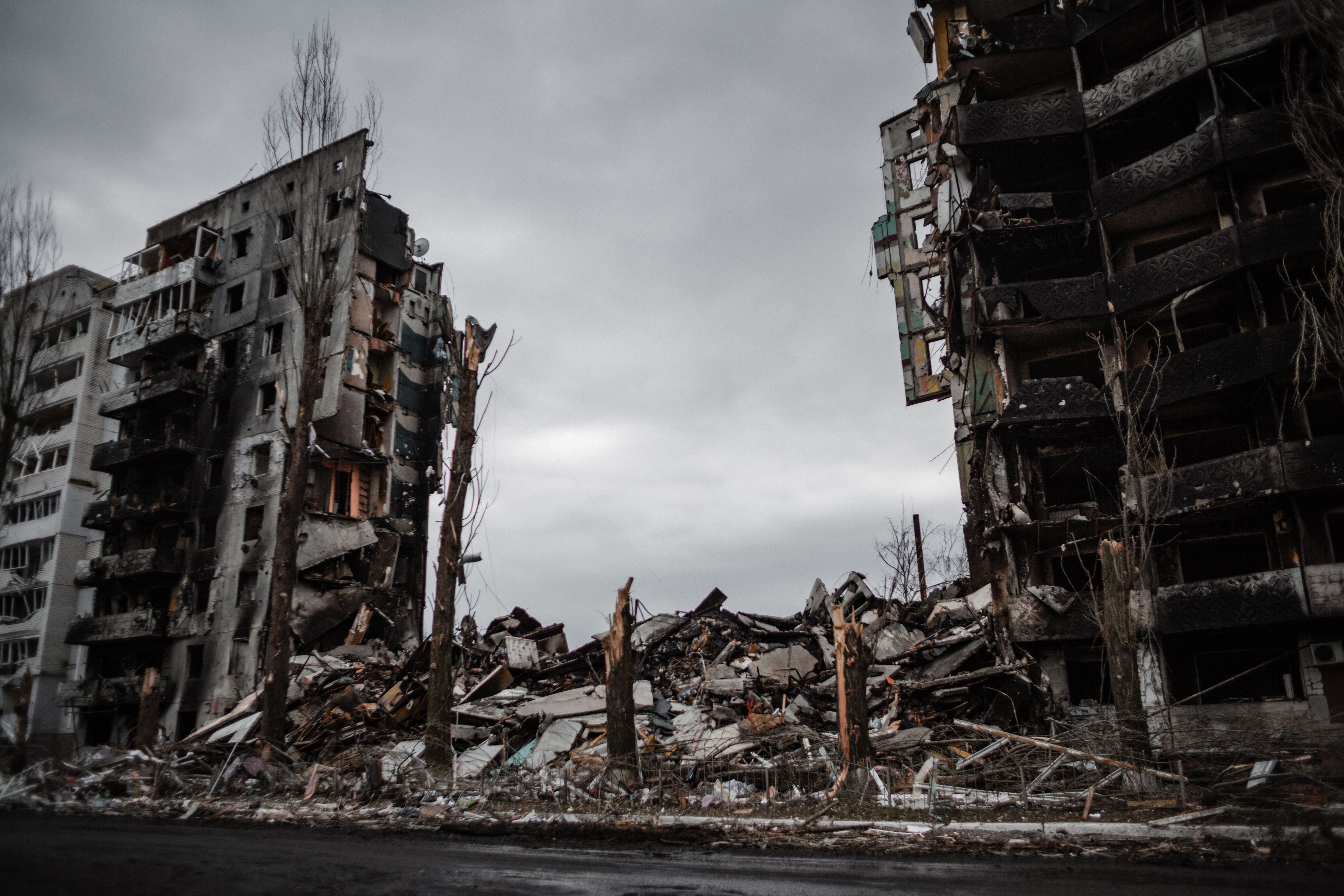
This post is a reflection on the poster titled ‘Domicide: the mass destruction of homes’ which I presented during the 25th Specialisation Course of the Siracusa International Institute for Criminal Justice and Human Rights (HR) - ‘International Criminal Justice, the Crimes Against Humanity (CAH) Convention, and Transitional Justice’. Attendance to the course was possible thanks to the support of the NNHRR Conference Grant.
Domicide – introducing the concept
Domicide entered the international legal realm in 2022, to address and reproach the mass destruction of homes. There is consensus among human rights courts and bodies that a home is much more than a shelter. It provides a place to live in security, peace and dignity (CESCR, General Comment No. 4, para 6) and protects the link that individuals have with a certain place (Ukraine and the Netherlands v Russia, para 1151). In this sense, homes provide a place for people to set roots, preserve memories, create a sense of belonging and identity and build social networks and communities. Upon destruction, both these tangible and intangible dimensions of home vanish.
My PhD puts this form of violence at the forefront of international law by inquiring how should international law – including human rights law (HRL), international criminal law (ICL) and international humanitarian law (IHL) - address domicide during armed conflict. This blog focuses on the HRL dimension.
Domicide - a mass human rights violation
Burning and demolition are traditional methods through which homes are destroyed mainly during non-international armed conflicts (NIACs) and situations of occupation. These practices can be traced in different contexts, including in South-East Turkey, Sudan or Colombia, and situations of occupation such as in Eastern Ukraine and the Occupied Palestinian Territories. In contemporary international armed conflicts (IACs), airstrikes and bombardments have become the paradigmatic method of home destruction, as in Ukraine or Gaza.
Cases of home destruction during conflict have increasingly reached human rights courts and have been addressed under the rights to privacy, property and prohibition of torture, but also under the right to life, the right to health and the right to adequate housing.
Right to privacy and right to property
Under the right to privacy, the European Court of Human Rights (ECtHR) has found that the burning and demolition of homes have no justification under Article 8.2 of the European Convention on Human Rights (ECHR) (Akdivar a.o. v Turkey, paras 18 and 25). The Inter American Court of Human Rights (IACtHR) has weighed the particular status of homes under the right to property to conclude that the loss of home entailed not only the loss of possessions but the social frame of reference for individuals (Ituango Massacres v Colombia, para 182), constituting a breach of the right.
Furthermore, human rights courts have also engaged with airstrikes under these same provisions. In Ukraine and the Netherlands v Russia (para 769) the ECtHR considered that Russia’s military attacks had caused enormous damage to private property in Ukraine, including homes. In fact, the Court found that the pattern of home destruction was part of an administrative practice of unlawful military attacks against civilians and civilian objects, and, in light of the lack of legal basis and breach of IHL, it concluded that it constituted a violation of Article 8 ECHR and Article 1 Protocol 1 to the ECHR (see here).
Prohibition of torture
Under the prohibition of torture, the ECtHR has focused on the manner in which homes were destroyed, considering the infirmity of the applicants and the traumatic circumstances surrounding the burning of the home (Selçuk and Asker v Turkey, para 78). Similarly, the IACtHR has weighted the emotional anguish caused by the loss of belongings and extreme violence surrounding the destructive spirals (Ituango Massacres v Colombia, para 272). In cases of airstrikes, the ECtHR has considered the fear and terror generated due to the failure to respect IHL that ultimately led to home destruction (Ukraine and the Netherlands v Russia, para 761).
Right to life
Using the concept of vida digna (decent life), the IACtHR has reiterated that the right to life includes, at least, those ‘minimum living conditions that are compatible with the dignity of the human person’ (Yakye Axa v Paraguay, para 161). Under this premise, the Court found that the destruction of homes constitutes a violation of the right to life in this socio-economic interpretation of the provision.
Right to health
The CESCR has acknowledged the close relationship between the right to health and the right to housing (General Comment No. 14, para 3) and has identified housing as a determinant condition for people to have a healthy life. The African Commission concluded that the destruction of homes, livestock and farms, and the poisoning of waters exposed the victim to serious health risks amounting to a violation of the right (COHRE v Sudan, paras 210-212).
Right to housing
Attacking, destroying and demolishing homes or rendering them uninhabitable constitutes the most direct interference with the right to housing. Already in 1998, the CESCR expressed concern about Israeli exclusionary policies and the impact they could have on the rights of the Palestinians (CESCR, para 21). It deplored the practices of demolition, land confiscation, and the policies resulting in substandard housing and living conditions, including extreme overcrowding and lack of services (CESCR, para 22). However, despite its centrality the right to adequate housing has featured in a limited manner in litigation of home destruction.
Domicide – human rights law and the CAH regime
The above is illustrative of the fact that human rights violations during armed conflicts do not distinguish between the civil, political, economic, social or cultural nature of the rights breached, reflecting the centrality of homes as a building block for individuals and societies.
These developments under human rights law, together with the fact that the destruction of a certain object such as homes can constitute a rights violation directly causing harm to individuals, are fundamental and should inform the advancement of ICL, especially the CAH regime.
During the course, we discussed how the CAH regime under Article 7 of the Rome Statute does not include the destruction of homes or violations of economic, social or cultural rights, as a direct attack on the civilian population per se. The Draft CAH Convention perpetuates such reality by sticking to the verbatim definition of Article 7 of the Rome Statute, at least in regards of this matter. Such an approach is not only disconnected from the reality under HRL but also makes the targeting of homes and similar objects a more appealing means of attacking the civilian population due to the envisaged lack of reproach.
Bio

Anna Maria Puigderrajols Triadó is a PhD candidate at the Europa Institute of Leiden University, where she previously completed the Advanced LL.M. in European and International Human Rights Law. Her doctoral research examines domicide, the destruction of homes during armed conflict, through an integrated analysis of international human rights law, international criminal law, and international humanitarian law.