Credits: Estephany Ximena Leon Rodriguez
By: Estephany Ximena Leon Rodriguez and Marianna Peroni
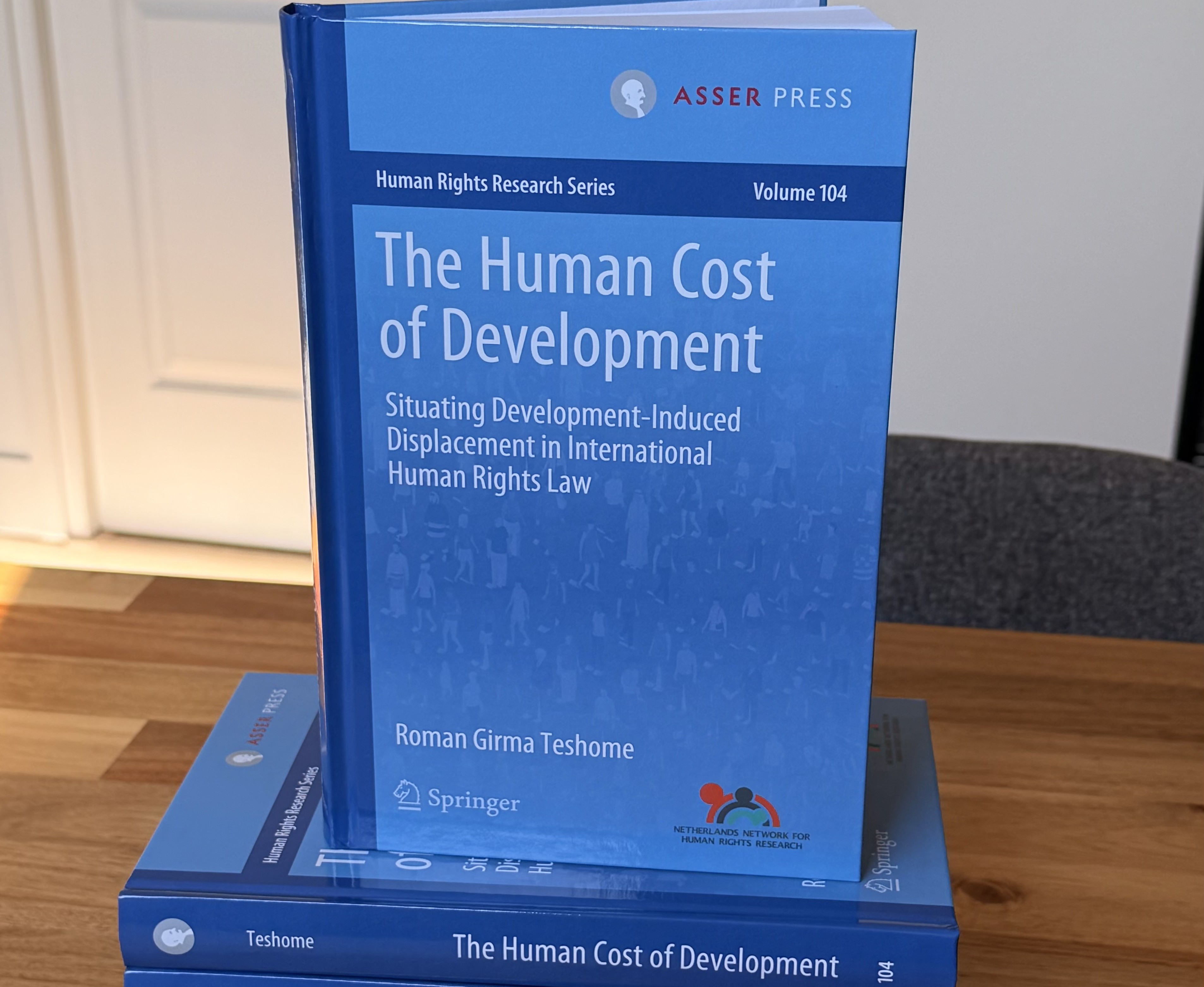
On the occasion of the publication of the first book in the reinvigorated Human Rights Research Series, namely “The Human Cost of Development: Situating Development-Induced Displacement in International Human Rights Law”, Estephany León Rodriguez and Marianna Peroni, interviewed its author, Dr. Roman Teshome.
The Human Rights Research Series offers leading scholarship on the evolving landscape of international human rights norms and their practical implementation. This collection explores the complex interplay between global standards and national legal frameworks, examining how human rights principles are interpreted, applied, and enforced across diverse contexts. Authored by NNHRR members, each volume in this series provides an in-depth analysis of critical issues at the intersection of law, policy, and human rights advocacy. The series encompasses a wide range of methodological approaches, from rigorous doctrinal analysis to innovative empirical studies, reflecting the multidisciplinary nature of human rights research. This series serves as an essential resource for academics, policymakers, legal practitioners, and human rights defenders seeking to deepen their understanding of contemporary human rights challenges. By bridging theoretical insights with practical applications, these books contribute to ongoing debates about the role of human rights in shaping just and equitable societies. The Human Rights Research Series aims to foster dialogue, inspire innovative approaches, and ultimately advance the protection and promotion of human rights at both the national and international levels.
1. Your book examines development-induced displacement through the lens of international human rights law. What motivated you to focus your research on this topic?
My interest in this topic stemmed from developments I closely followed in Ethiopia, where I am originally from. While I was completing my law degree and later my master's in human rights law, the displacement of people for development purposes had become a prominent issue in public debate.
As a country that embraced a developmental-state model during this period, Ethiopia pursued numerous state-led, large-scale development projects and programmes. While these initiatives were intended to promote economic development, they often resulted in the displacement of people from their homes and lands, sometimes without adequate compensation or safeguards. The consequences can be profound: displacement disrupts livelihoods, social networks, and community structures. For people whose livelihoods depend on land and for Indigenous Peoples whose cultural identity and way of life are closely tied to their ancestral territories, the impacts can be particularly severe.
The issue was not only a legal and policy concern but also a politically significant one. Concerns about displacement and land rights were among the factors that contributed to the widespread protests that took place in Ethiopia in 2015 and 2016, which in turn led to a range of human rights violations.
Although my initial interest was shaped by developments in Ethiopia, I soon realized that development-induced displacement is a global phenomenon affecting millions of people across different regions, making it an important issue for international human rights law more broadly.
As a human rights lawyer, I became increasingly interested in understanding how international human rights law addresses the harms associated with development-induced displacement and whether existing legal frameworks provide adequate protection for those affected. This curiosity ultimately led me to develop a doctoral research proposal after completing my LL.M. in Human Rights, and that research has now culminated in this book.
2. What are the key legal or normative gaps your book identifies?
The book identifies a range of normative gaps in the existing international human rights framework as it applies to development-induced displacement. Since it would be difficult to cover all of them here, I would highlight three broader gaps that emerged from the research (pp. 286-294).
First, international human rights law does not recognize a general right to land. While land-related interests are protected indirectly through rights such as the rights to property, housing, and food, and while stronger protections exist for specific groups such as Indigenous Peoples and peasants, there is no universal right to land applicable to all. This is a significant gap because the acquisition of land is the primary driver of displacement, and loss of access to land is often the main source of impoverishment and vulnerability for those affected.
Second, there is limited normative guidance on the remedies and safeguards that should be provided to people affected by this form of displacement. International human rights law requires states to provide remedies for human rights violations, but it offers relatively little guidance on what adequate remedies should look like in this specific context. Questions relating to the type of compensation, livelihood restoration, resettlement assistance, and long-term rehabilitation often remain insufficiently addressed.
Third, the existing human rights framework has not been adequately contextualized to reflect the distinctive features of displacement prompted by development projects. Much of the normative development on displacement has focused on displacement caused by armed conflict or natural disasters. Development-induced displacement, however, differs in important respects: it is typically planned, foreseeable, and carried out or authorized by the state itself. As a result, legal standards developed with conflict or disaster-related displacement in mind do not always provide sufficient guidance for addressing the particular risks associated with development-induced displacement.
Taken together, these gaps suggest that while international human rights law offers an important foundation for protecting affected individuals or groups, further normative development is needed to respond effectively to the realities of development-induced displacement.
3. What does a human rights-based approach add to existing scholarship on development and displacement?
Broadly speaking, a human rights-based approach adds a legal dimension to existing scholarship. Much of the scholarship on development-induced displacement has been produced by sociologists, anthropologists, and development scholars. Their work has been invaluable in documenting the social, economic, and cultural consequences of displacement and in highlighting the experiences of affected communities. However, the legal dimensions of development-induced displacement, particularly the extent to which international human rights law responds to its multifaceted consequences, have received comparatively limited attention.
Similarly, the international legal literature on internal displacement has focused predominantly on displacement caused by armed conflict and natural disasters, rather than displacement resulting from planned development interventions. This is the gap that my book seeks to address.
More specifically, a human rights-based approach involves integrating human rights norms and principles into development processes. In the context of development-induced displacement, this means viewing displacement not merely as an inevitable cost of development or as a technical resettlement challenge, but as a human rights issue that engages the rights and entitlements of affected individuals and groups.
Using this approach, the book reframes the consequences of development-induced displacement through the lens of international human rights law and systematically examines the legal obligations that arise before, during, and after displacement. It identifies the relevant international legal frameworks, analyses the substantive and procedural safeguards they provide, and critically evaluates their strengths, limitations, and normative gaps.
In doing so, the book contributes to existing scholarship in three ways. First, it brings international human rights law into conversations that have traditionally been dominated by development and social science perspectives. Second, it provides a comprehensive legal framework for assessing the human rights implications of development-induced displacement. Third, it demonstrates how human rights norms can be used not only to evaluate development practices but also to guide the design of more equitable and accountable development policies and resettlement processes.
Ultimately, a human rights-based approach helps shift the focus from development projects alone to the people who bear their costs and ensures that their rights, dignity, and long-term wellbeing remain central to development decision-making.
4. Development projects are often financed by international financial institutions. What role do you think these institutions should play in ensuring that development-induced displacement complies with human rights standards?
International financial institutions (IFIs) play a crucial role in the context of development-induced displacement as they often finance the large-scale development projects that give rise to involuntary displacement. Their influence extends well beyond funding; they also play an important norm-setting role through the policies and safeguards that borrowing states are required to follow as a condition of receiving financial support.
Many IFIs have developed relatively comprehensive policy frameworks on involuntary displacement and resettlement. These frameworks establish standards for project planning, consultation, compensation, livelihood restoration, and resettlement assistance, and they can provide important protections for those affected by development projects.
Importantly, IFIs also possess a degree of leverage that is often lacking in other parts of the international legal system. Because they control access to project financing, they have a unique capacity to incentivize compliance with their safeguards and shape state behaviour in ways that many international legal mechanisms cannot. As is often observed, international law frequently struggles with enforcement; IFIs, by contrast, can attach concrete conditions to funding and monitor compliance throughout the life of a project.
At the same time, the book argues that these institutions have generally been reluctant to integrate human rights explicitly into their policies and operational frameworks. In my view, this contributes to the persistent gap between policy commitments and the lived experiences of affected communities, many of whom continue to face long-term socio-economic hardship and human rights risks as a result of displacement.
While IFIs may not have an explicit human rights mandate and their safeguard policies do not formally form part of the international human rights law regime, their activities overlap significantly with the protection and realization of human rights. For this reason, I argue that their policies and practices should be informed more directly by relevant human rights standards. Doing so would not only strengthen the protection of the rights of people affected by development projects but would also help these institutions achieve their own development objectives in a more equitable, sustainable, and accountable manner.
5. What advice would you give to PhD researchers today who are considering publishing their thesis in the NNHRR Human Rights Research Series?
I would certainly encourage PhD researchers to consider it. Publishing a dissertation can seem like a daunting process after completing a PhD, but my experience with the NNHRR Human Rights Research Series was very positive.
The publication process was smooth and relatively efficient, and I greatly appreciated the support provided by the team at the T.M.C. Asser Institute throughout the process. They were professional, responsive, and supportive in helping transform my doctoral thesis into a published book.
Another advantage is the visibility and reputation of the series within the human rights research community, particularly in the Netherlands. It provides an excellent platform for disseminating one's research to both academic and professional audiences, and offers valuable opportunities for collaboration, networking, and engagement with other scholars in the field.
Bios

Estephany Ximena Leon Rodriguez is a Peruvian lawyer (PUCP, Summa Cum Laude) and Erasmus Mundus scholar specializing in international human rights, migration, and transitional justice, with working experience at the Asser Institute, IACHR, CEJIL, and the Constitutional Court of Peru, among others.

Marianna Peroni is a lawyer and LL.M. graduate in Public International Law from the University of Groningen (cum laude). Her research focuses on State responsibility, human rights, humanitarian law, and business and human rights, with a particular interest in accountability mechanisms for mass atrocities and the role of international organisations.