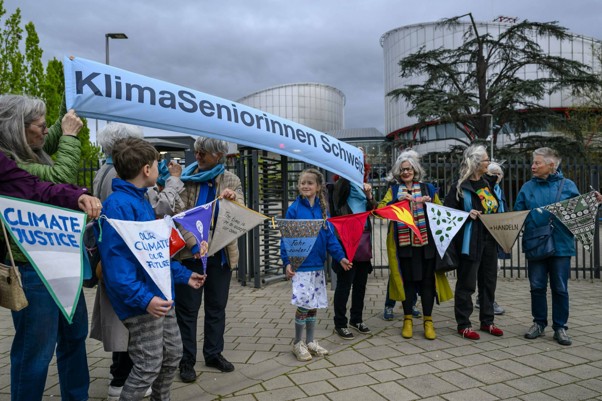
Credits: Jean-Cristophe Bott in Rheinische Post.
Introduction
In 2020, the organisation Verein KlimaSeniorinnen Schweiz, as well as individual members of it, filed their application to the European Court of Human Rights (ECtHR), arguing that the Swiss government’s inability to provide adequate climate measures and meet climate mitigation targets have led to violations of Article 2 (right to life) and Article 8 (right to private life) of the European Convention of Human Rights (ECHR). The question of future generations was present from the beginning, as the organisation claimed to act also in the interests of future generations, and continued to be brought up during the litigation process as well. In its judgement from 2024, the Court discussed this pressing matter, taking an important step forward in climate change litigation. At the same time, the disparate approach that the Court took in relation to the admissibility of the different types of applications and to the issue of victim status, has raised new stakes, and questions, to the way future generations will continue to be represented.
The Concept of ‘Intergenerational burden-sharing’
In the context of climate change, the Court recognised that the principle of ‘intergenerational burden-sharing’ gives rise to several State obligations in respect to future generations (2024 judgement, para. 420). These include considerations for future generations when States decide on policies to combat climate change, as these choices will inevitably impact future generations (para. 419-20). The Court hence characterised future generations as the ‘future burden bearers’ of today’s State omissions and failures in taking adequate action. And while future generations will have to be the ones to bear the consequences, they do not have the possibility to participate in current decision making (para. 420). Furthermore, State’s legal obligations under the ECHR can only include current individuals under their jurisdiction. Despite these legal and temporal limitations, the Court nevertheless argued that due to intergenerational burden-sharing, State obligations to protect the climate system include the benefits for future generations (para. 420). It emphasised the primary duty of States to adopt and implement effective policies to mitigate the present and future effects of climate change (para. 545). Such duty arises to avoid, or mitigate, a burden on future generations (para. 549). Lastly, States have an obligation to take adequate action for those whose rights under the Convention will be affected in the future, in the absence of timely action (para. 499).
Admissibility of Applications - Individuals v. Associations
The Court’s most controversial take in the judgement was the different approach in relation to the admissibility of the individual applications and those of the applicant association. The Court argued that individuals must prove that they have been ‘personally and directly affected’ by State omissions in fulfilling their obligations, and due to a lack of that, the individual applications were ruled inadmissible (para. 487). Case law concerning ‘potential’ victims could not be applied to climate change cases, as it would concern ‘virtually anybody’ and would not constitute a ‘limiting criterion’ (para. 485). At the same time however, the legal standing of associations was allowed in the context of intergenerational burden-sharing (para. 489). The Court recognised that climate litigation poses administrative, legal and financial burdens on individuals claiming victim status (para. 489, 497). Furthermore, it argued that action through associations might be the only way through which the interests of those at a ‘distinct representational advantage’ could be considered and through which they could influence decision-making processes (para. 489). It hence viewed associations as means through which climate litigation can be done on behalf of affected individuals (para. 497).
The extensiveness of climate change’s impact hence became a limiting factor for who can constitute a victim. At the same time, the Court considered the demands of climate change to broaden the scope of participation in climate litigation at the ECtHR, justifying the legal standing of associations.
The Paradox of the Victim Status
Most interesting was the Court’s approach to victim status. While allowing the legal standing of associations, it made sure to underscore that associations are not natural persons and hence cannot claim victim status for any issue under Article 2 and/or 8 ECHR (para. 496). Individual applications lacked victim status under Article 34 ECHR (para. 535). Yet, when the same individuals were represented by the association, meeting the victim status criterion was no longer required for both them and the applicant association acting on their behalf (2024 judgement, para. 502).
Furthermore, the Court only looked at the issue under Article 8 ECHR, while the applicability of Article 2 ECHR was questionable (para. 536). The issue fell within the scope of Art. 8 ECHR, as the alleged State shortcomings indeed affected human health. However, whether such consequences were also life-threatening, and hence could trigger the applicability of Art. 2 ECHR as well, was uncertain (para. 536). Climate change indeed impacted individuals’ life, but the challenge was establishing the degree of severity of the impact. The Court however refrained from elaborating how a violation of the right to private and family life, a human right that has been recognised as being inherently personal, could be claimed by an association.
Looking Ahead
The KlimaSeniorinnen case was one of the first instances where the question of future generations was addressed. The Court recognised that principles such as ‘intergenerational burden-sharing’ are vital in today’s choices (para. 420). States responsibility for their decisions assumed another layer, namely their accountability for the enjoyment of Convention rights by future generations. The Court hence acknowledged the future impact of today’s choices and the importance of future generations, but it did not go so far as to grant them legal recognition. That would certainly create a series of new legal challenges for the Court to consider. For instance, how could Convention rights be attributed to individuals who are yet to be born? Could future generations be regarded as ‘natural persons’ within the meaning of the individuals protected by the ECHR? How could concerns for the protection of future generations be reconciled with the temporal limits of Convention rights?
Furthermore, the judgement left many questions unanswered, such as the scope of the term ‘future generations,’ or the exercise of inherently personal Convention rights by legal entities that are not natural persons. The legal standing of associations has been the subject of several debates, with scholars claiming that the Court essentially allowed actio popularis. KlimaSeniorinnen hence brought significant developments in climate litigation, but much still needs to be done, and answered, in relation to future generations.
Bio

Maja Versa is a second-year student at Leiden University College The Hague, majoring in International Justice. She participated as a student researcher in the Research Clinic “Climate Litigation by Future Generations,” supervised by Dr. Otto Spijkers.