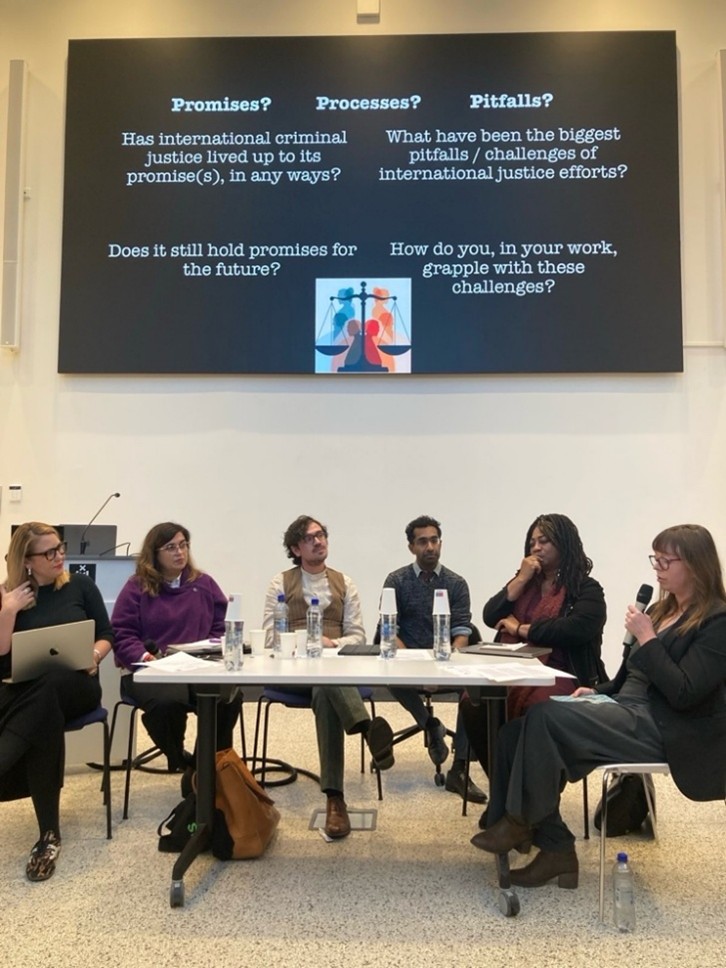
Credit: Adina-Loredana Nistor. L to R: Kate Gibson, Olivera Simić, Benjamin Thorne, Pubudu Sachithanandan, Kamari Clarke, Lucy Gaynor.
Introduction
By 2025, the international legal order, and its mechanisms for delivering justice, seem to be under assault on an almost daily basis. This current crisis has sparked a kind of moment of reckoning for the international criminal justice project. On Thursday 4 December 2025, while the International Criminal Court’s (ICC) annual ‘Assembly of States Parties’ took place in The Hague amidst a swarm of sanctions, criticisms, and accusations against its chief prosecutor, a group of experts came together at the University of Amsterdam for a morning of wide-ranging, thought-provoking and insightful discussions about international criminal justice (ICJ). The roundtable, “Promises, Processes, and Pitfalls in International Criminal Justice Today” was organised by Lucy Gaynor, Maartje Weerdesteijn, Barbora Holá, and Adina-Loredana Nistor.
Thanks to the sponsorship of the Netherlands Network of Human Rights Research (NNHRR) and the Centre for International Criminal Justice (CICJ), the organisers were delighted to welcome our roundtable speakers: Benjamin Thorne, Assistant Professor of Criminal Law at the University of Reading; Kamari Maxine Clarke, Distinguished Professor of Transnational Justice and Sociolegal Studies at the University of Toronto; Kate Gibson, Defence counsel before the International Criminal Tribunals for the former Yugoslavia and Rwanda, the Extraordinary Chambers in the Courts of Cambodia, Special Court for Sierra Leone, International Criminal Court, and the Kosovo Specialist Chambers; Olivera Simić, Professor at Griffith Law School, feminist and human rights activist; Pubudu Sachithanandan, Trial Lawyer in the Office of the Prosecutor at the International Criminal Court.
Has International Criminal Justice Lived Up to its Promises in Any Ways?
Kamari Maxine Clarke reflected upon the creation of the ICC with the Rome Statute in 1998. In her opinion, the political “euphoria” of establishing the Court perhaps obscured the extent to which legal aspirations were intricately tied up with political goals and negotiations: a fact which has since become painfully clear, as the Court has struggled to obtain and sustain co-operation from states when it does not act in their interest. What we saw in 2025, Benjamin Thorne pointed out, is a lack of state support for the ICC when it was most needed. Pubudu Sachithanandan’s musing that a Rome Conference in 2025 would be unlikely to result in a Court was met with weary smiles and nods from the audience. The sense of promise created by the 1998 euphoria has, in that regard, well and truly worn off.
What emerged from the roundtable, however, was not a kind of black-and-white despair over current crises while hearkening back to former glories. The speakers offered a nuanced and thoughtful approach to the flaws built into the system, and the fire that might now be in the news on a daily basis but has in fact been coming from inside the house since the ICC’s first years in operation. In the international consciousness, the politically contingent potential of the ICC seems to have reached a saturation point, with the ever-looming threat of sanctions from the USA, and the apparent impunity with which those facing ICC arrest warrants can (and have) travelled the globe, including to states technically under an obligation to secure their arrest. But this current crisis is just one iteration of a kind of problem which has plagued the Court since its beginnings. The ICC was still in its infancy when its first chief prosecutor, Luis Moreno-Ocampo, announced an investigation into the violence of the Lord’s Resistance Army (LRA) in Northern Uganda, at a press conference given alongside Ugandan President Yoweri Museveni. Ever since, the Court has struggled to overcome perceptions of politicised justice in Uganda. The entanglement of law and politics within international criminal justice, so whitewashed by the euphoria of the Rome Statute, has both shaped and stymied the promises which international criminal justice (ICJ) actors in general, and ICC actors in particular, have been able and willing to make since its inception. The current crisis at the ICC starkly reveals the political priorities that underlay much of the apparent unity behind the Court’s creation.
If the promises made by international justice actors have caused one set of problems, the promises received by international justice audiences have undoubtedly caused another. Pubudu Sachithanandan noted that “promise” is in the eye of the beholder and wondered “what we thought it [the ICC] was going to do?”. The promise of international criminal justice, for some, was that it would become some kind of conviction machine, he reflected. For Kate Gibson, the core problem of states support for the ICC is that it centres around this promise of convictions, without considering the possibility of, and need for, acquittals or dropped charges. She highlighted how states’ engagement with the ICC reinforces this perception. By way of example, the ICC’s Trust Fund for Victims, which only compensates (often a small subset of) those impacted by violence in the case of a conviction, is often the main focus of states’ publicity around their support for the Court. Victims of international crimes – arguably the group to and about which the ICC has made the most, and biggest promises – only benefit conditionally, and in small numbers.
What are the Biggest Challenges of International Criminal Justice Efforts?
Proximity and transparency were raised time and again as the two big challenges to international justice efforts today. Kate Gibson emphasised that proximity matters not only to victims and affected, but for trial actors’ understanding of the cultural contexts of the situations they work on. Olivera Simić spoke about the ongoing prevalence, across the former Yugoslavia, of war hero stories about those convicted by the International Criminal Tribunal for the former Yugoslavia (ICTY). She also explained that, on a local level, victims will often just “bump into” perpetrators. In the former Yugoslavia, for victims and perpetrators alike, then, international criminal justice – despite the ICTY – is a kind of distant, detached phenomenon, which does not reflect their lived realities. Pubudu Sachithanandan echoed Gibson and Simić’s reflections and noted that international versus domestic justice efforts are often seen as competing, rather than informing and assisting each other, thus leaving huge gaps in terms of how justice is felt (or not) within affected communities.
Contributing to international criminal justice’s proximity problem is, according to several of the roundtable speakers, its transparency problem. For Kamari Clarke, the “euphoric” lens so often applied to stories of international criminal justice obscures its deeply political nature. For Benjamin Thorne, the ICC’s self-positioning as a “global leader in accountability technology”, combined with its complete lack of transparency around its use of such technology, is an eerie echo of the Court’s over-promising and under-communicating around victims. Finally, according to Olivera Simić, international justice can often out-shout, and thus undermine domestic justice, or render it invisible, rather than truly “complementing it” as so many modern international justice initiatives claim to do. An example of this can be found in the case of the former Yugoslavia where, despite hundreds of domestic proceedings against perpetrators, hardly anybody watched them.
Conclusion
If international criminal justice has failed in its promises, the consensus among the speakers seemed to be that this failure is a result of misaligned expectations and political priorities, as well as one-sided, or over-exaggerated promises to a mosaic of actors, observers, and interest groups. Different audiences to international criminal justice bring their own priorities, perceptions, and preconceptions to the table, which also influence how they receive the promises ICJ actors make. The way forward seems to be through more transparent and co-operative processes and structures, more honest promises, and more inclusive, proximate, and culturally sensitive initiatives.
Bio

Lucy J. Gaynor is a PhD candidate at the University of Amsterdam and NIOD-Institute for War, Holocaust, and Genocide Studies.