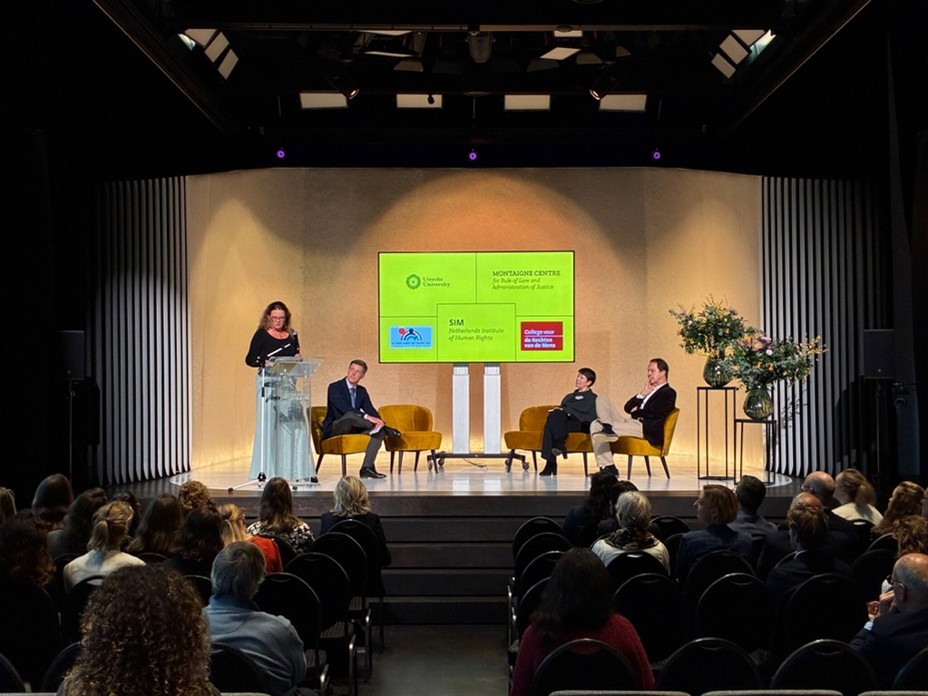
Credit: Sam Hoogendoorn and Antoine Buyse
75 Years is a venerable age for any person, but also for Europe’s most fine-grained and influential human rights treaty: the European Convention on Human Rights (ECHR). Yet, as this milestone was reached on 4 November 2025, the Convention and its Court also faced the most concerted and concerning critiques in their history from the side of their own state parties.
The most visible initiative was the by now infamous ‘Letter of Nine’ of May 2025 in which a group of states heavily criticized the Court for having gone “too far” and mentioning the need to “restore the right balance”. The letter, on which one of us reported here, specifically focused on irregular migration and the decreased leeway these states felt to expel criminal foreign nationals as a result of the Court’s case-law. Although the letter called for “an open-minded conversation” on these issues, it was seen by many as a frontal attack on the Court. The political noise-making triggered an exceptional Ministerial Conference in December 2025, in which it was announced that the Council of Europe’s member states would work towards a political declaration on the issue somewhere in 2026 (see more on this topic here).
The above could give the impression that the Convention and its Court are fragile. Yet, the debate around the case-law of the Strasbourg Court is more multi-faceted than the critique of these states reflects. For each voice stating that the Court goes too far in expanding the scope of the Convention’s rights or in restricting the power of states, one can find critiques from the other side, with human rights organisations and victims of human rights violations stating that the Court is not going far enough in protecting rights (see the many comments on the Court not going far enough here).
Thus, the 75th anniversary of the Convention is a good moment to take stock. To do so with a focus on the Netherlands, a triad of events was organized on Friday 14 November 2025, in a special collaboration of the Montaigne Centre for Rule of Law and Administration of Justice, the Netherlands Institute of Human Rights (SIM), the Netherlands Institute for Human Rights (the Dutch NHRI) and the Netherlands Network for Human Rights Research (NNHRR). First, a lunch took place with Jolien Schukking, the Judge at the European Court of Human Rights elected in respect of the Kingdom of the Netherlands, as the main guest. Under Chatham House rules, academic ECHR experts from various universities in the Netherlands, exchanged views with the Judge. Subsequently, Antoine Buyse and Janneke Gerards chaired a special mini symposium on 75 years of ECHR in the Netherlands. Finally, the afternoon wrapped up with the 2025 SIM Peter Baehr lecture, ‘A House of Stories: 75 years of protecting human rights through the European Convention on Human Rights’, delivered by Judge Schukking.
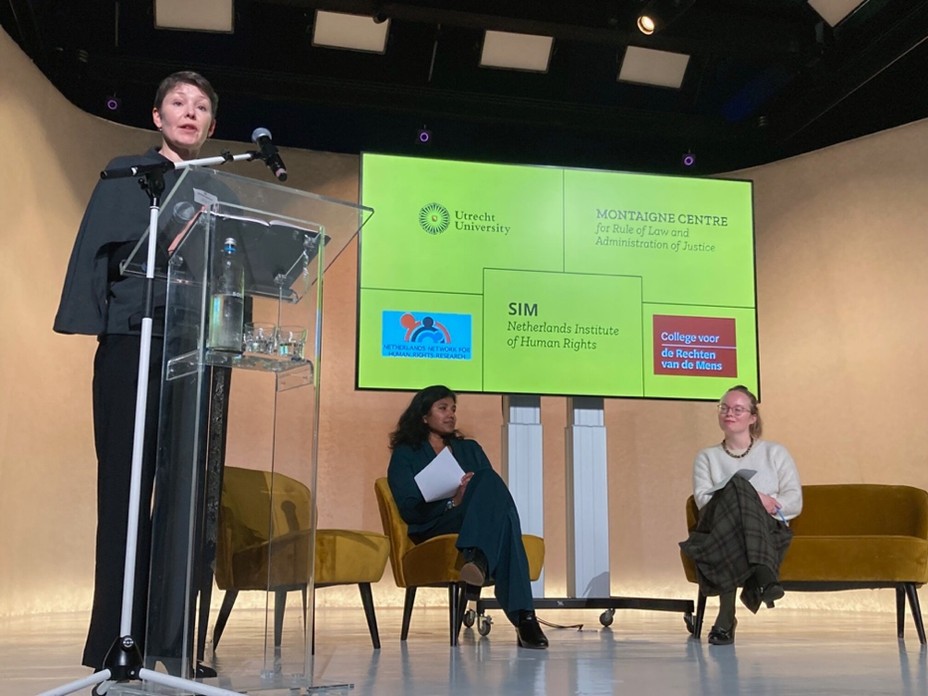
Credit: Sam Hoogendoorn and Antoine Buyse
The first panel of the mini symposium focused on the interactions between the Strasbourg system and the Dutch legal order. Babette Koopman, the agent of the Kingdom of the Netherlands at the European Court, emphasised the importance of the Convention over time. Janneke Gerards analysed how in the Advisory Division of the Netherlands Council of State and Dutch courts apply the Convention on a daily basis and how they are assisted and inspired in their work by the case-law coming from Strasbourg. Finally, Rick Lawson, chair of the Dutch NHRI, placed the embeddedness of the Convention in the Netherlands in a historical perspective and highlighted the role of the Netherlands Institute for Human Rights in the implementation phase of the judgments of the Court pertaining to the Netherlands.
The second panel took a substantive angle by focusing on the meaning and effects of ECHR rights and case-law on equal treatment and non-discrimination. Veni Naganathar, vice-chair of the Dutch NHRI, elaborated on how the ECHR play a role in the dispute settlement mechanism on discrimination complaints. Alexandra Timmer, associate professor at Utrecht University, analysed how the Court’s case-law provides starting points to tackle systemic discrimination.
In her lecture, Judge Schukking added a further dimension by spotlighting the stories of people underlying each case ending up in the Court’s docket. Each judgment in which the Court finds a violation reflects a tragic encounter of human beings with injustice, such as the one from the family members of the people who died in the downing of the MH-17 above Ukraine to the victims of domestic violence. The experiences of these thousands of victims and the way they are rendered in the case-law has, in Schukking’s view, made the Court into a true ‘house of stories’. In spite of the recent concerns voiced by some states, the many ways in which the Court has interpreted the Convention serve to maintain human rights as living realities, now and in the future. As Schukking aptly phrased it: “Together we must ensure that the light of justice never dims in Europe’s House of Stories”.
Bios

Prof.dr. Antoine Buyse is full professor of Human Rights from a Multidisciplinary Perspective and director of the Netherlands Institute of Human Rights (SIM) at Utrecht University.

Prof.mr. Janneke Gerards is State Councillor at the Advisory Division of the Council of State of the Netherlands. For one day a week, she is affiliated to Utrecht University as full professor of European Fundamental Rights Law.