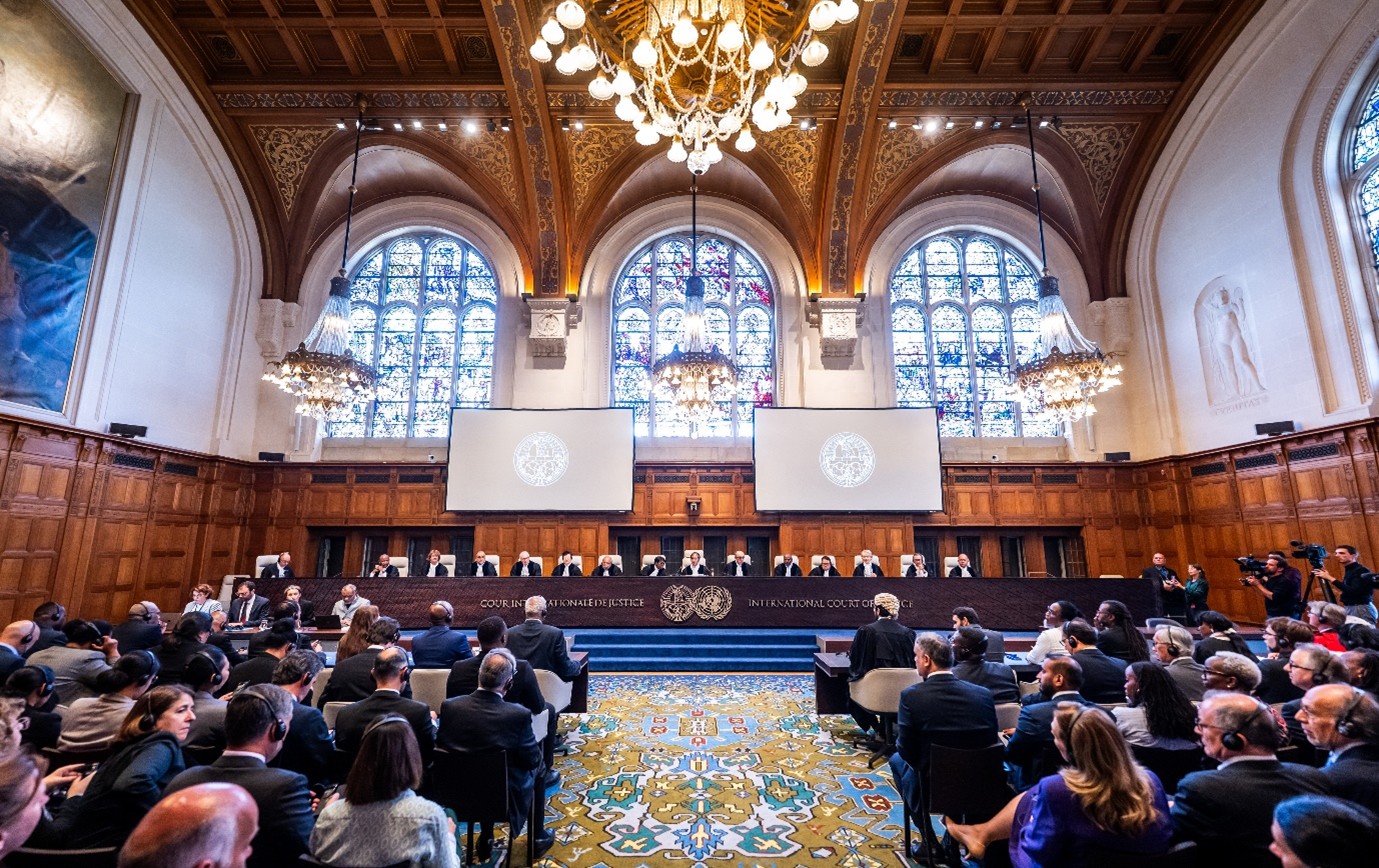
Credit: International Court of Justice
Introduction
On the 23 July, 2025, the International Court of Justice (‘the ICJ’ or ‘the Court’) rendered its timely and much anticipated advisory opinion on the obligations of States in relation to climate change (the ‘advisory opinion on climate change’ or ‘advisory opinion’). The proceedings preceding the Opinion registered a record number of participants, as never seen before in the Court’s history handling similar proceedings.
Notably, the ICJ’s advisory opinion was preceded by some significant judicial pronouncements by regional human rights courts – specifically, the European Court of Human Rights (ECtHR) and the Inter-American Court of Human Rights (IACtHR) – on the obligations of states to protect human rights against climate change, alongside a flurry of groundbreaking national court decisions (See inter alia, Urgenda, Neubauer). These developments were not lost on the Court and it explicitly took cognizance of them in its decision (para 385).
However, being the ultimate arbiter on questions of international law, the ICJ’s advisory opinion could not have come at better time. With some of the largest emitters either watering down their emission reduction targets or even pulling out of international climate change treaty commitments. Already, climate scientists warn that the global carbon budget required to stay within the 1.5oC temperature goal under the Paris Agreement could be depleted in approximately three years. Hence, aligning itself with the climate science, the ICJ unequivocally held in its advisory opinion that the obligations imposed on States by international law (para 404) are stringent and must be executed with due diligence. This means that States have only very limited discretion (paras 245-254) in discharging these obligations, including in setting their nationally determined contributions (NDCs), which are considered the ‘heart’ of the mitigation obligations under the Paris Agreement. The Court’s decision contradicts what some States, including the United States, have argued – emphasising ‘national discretion’ with respect to the preparation, communication, and maintenance of NDCs (Written statement of the USA, para 4.26).
The ICJ’s advisory opinion justifiably elicited reactions in various circles. It was heralded as historic not only for addressing the question of State obligations in combatting climate change, but also for its potentially far-reaching consequences for the regulation of private emitters.
This blogpost joins the foray, focusing on the Court’s treatment of the concept of future generations. The central argument advanced in this blogpost is that the Court’s advisory opinion unequivocally affirms that future generations can be ascribed ‘interests’, effectively elevating these interests from abstract concepts to legally recognizable objects. While these interests have previously been pursued in domestic and regional climate litigation in Europe—often by linking them with the rights of other closely related groups, especially children—the ICJ’s advisory opinion instructively affirms that the interests of future generations are, in themselves, justiciable.
Background
Looking at past case law, this was in fact not the first time that the Court has made a pronouncement on ‘future generations’, especially in relation to environmental protection. One example is the Court’s advisory opinion on the Legality of the Threat or Use of Nuclear Weapons (para 29). In that case, Judge Weeramantry in his dissenting opinion made what has perhaps remained the most forceful case for attributing rights to future generations noting that ‘the rights of future generations have passed the stage when they were merely an embryonic right struggling for recognition’. He saw the Court as duty bound to recognise those rights (p. 233). Even so, the Court is yet to recognise these rights.
The ICJ’s advisory opinion on climate change constituted the first time the Court has interpreted an obligation for States to take into account the interests of future generations in order to comply with their obligations to combat climate change. To quote verbatim, the Court held that, '[d]ue regard for the interests of future generations and the long-term implications of conduct are equitable considerations that need to be taken into account where States contemplate, decide on and implement policies and measures in fulfilment of their obligations under the relevant treaties and customary international law' (para 157).
In her separate opinion, Judge Sebutinde criticised the advisory opinion’s vagueness, arguing that the Court should have more clearly stated that the identified obligations are owed to both present and future generations, rather than leaving this to State discretion (para 7). Even so, the Court’s direct invocation of the interests of future generations marks a positive step toward factoring them into present policy and political decision-making.
Now, it is important to note here the language adopted by the Court in its advisory opinion. A cursory reading divulges that it ascribes not rights but interests to future generations as objects (referring to the ‘rights’) which must be taken into account as a matter of equity. A whole debate can be had about what difference this makes, but I desist from engaging in that here. Nonetheless, one might ask whether future generations can now be said to have interests? And if so, are these justiciable? I address these questions below, under the section on the justiciability of the interests of future generations.
But for now, we need to zoom out a bit.
‘Interests’ of future generations: the long road to recognition by the ICJ
For long, climate science has indicated that the adverse effects of Greenhouse gas (GHG) emissions are enduring and take decades, possibly even centuries, to become apparent. This means that future generations are in the unenviable position of bearing the brunt of our current actions and decisions that perpetuate the emission of GHGs. This point is only an iteration of what has been already said by others (See for instance Gardiner who refers to climate change as an ‘intergenerational storm’).
Despite this, and as already noted, prior to the ICJ’s advisory opinion on climate change, the Court had not acknowledged with such clarity that future generations possess intrinsic interests. For instance, in its advisory opinion on the Legality of the Threat or Use of Nuclear Weapons, it only spoke of how, ‘the environment is not an abstraction but represents the living space, the quality of life and the very health of human beings, including generations unborn’ (para 29). In the Gabcikovo-Nagymaros Project case, which concerned a dispute between Hungary and Slovakia over the former’s suspension and discontinuation of a joint venture to construct a barrage system on the Danube, the Court only commented in passing about the recognition of the risks posed by anthropogenic interference with the environment to present and future generations (para 140).
Subsequently, in its judgment in the Pulp Mills case, concerning Argentina’s objection to Uruguay’s ‘authorization, construction and future commissioning of two pulp mills on the River Uruguay’ as a breach of the treaty between both countries on that matter, the Court conspicuously avoided making any allusion to future generations. An omission which Judge Cançado Trindade protested in his separate opinion, expressing disappointment in the Court’s failure to develop its jurisprudence by engaging with the intertemporal dimension of environmental damage as concerns ‘present and future generations’ (para 119). The advisory opinion on climate change therefore represents an important milestone in the development and expansion of the Court’s jurisprudence relating to future generations.
Developments at regional and domestic levels
As noted in the introduction, the ICJ’s advisory opinion on climate change came on the backdrop of various judicial decisions on climate change at both regional and domestic levels.
At the regional level, the IACtHR in its advisory opinion on climate change, noted that States have a duty to ensure that current generations leave behind a stable climate for future generations (para 308). Similarly, the ECtHR, highlighted the need to ensure equitable ‘intergenerational burden sharing’ in climate decision-making (KlimaSeniorinnen, para 420). Similar developments are equally discernible in domestic contexts like Germany where, the Federal Constitutional Court while noting that the unborn or future generations could neither have nor ‘enjoy subjective fundamental rights’, it ultimately, enjoined the political process to look to the future beyond the present ‘directly expressible interests’ (BVerfG, 1 BvR 2656/.18, 1 BvR 96/20, 1 BvR 78/20, 1 BvR 288/20, para 109, 205). The foregoing decisions reflect the different jurisdictional nuances in the judicial perception of future generations which the ICJ’s advisory opinion built on and consolidated.
Justiciability of the ‘interests’ of future generations
The ICJ’s advisory opinion on climate change makes clear that future generations have justiciable interests (para 157). As to how and by whom these interests are to be enforced (given the non-existence of ‘future generations’) remains a different question altogether. The advisory opinion establishes that the interests of future generations are claims which ought to be respected by the State and are therefore capable of judicial enforcement.
By way of analogy, in a number of domestic legal contexts there are instances where interests of entities or individuals are deemed justiciable or legally protectable even though those entities or individuals have no ‘legal agency’ of their own. One such instance is for instance the legal doctrine of ‘the best interests of the child’ also referred to as the ‘welfare principle’. This doctrine enjoins a court or other authority to take into account the ‘best interests of the child’ when deciding on any matter touching a child (even when the child concerned is not before the decisionmaker). It has been acknowledged as paramount and variously applied by inter alia the ECtHR (See Neulinger, para 135) and the Supreme Court of the United Kingdom (ZH (Tanzania), paras 26, 33). Although the foregoing necessarily oversimplifies the doctrine of ‘the best interests of the child’, courts routinely consider a child’s best interests even where the child is unable to express their views. On this basis, they can likewise give effect to the interests of future generations.
As to what those interests are, the simple approach to answering this question would be to primarily restrict ourselves to the environment of which the climate system is a component. This is guided by the ICJ’s own take in its advisory opinion on climate change that, ‘[t]he environment is the foundation for human life, upon which the health and well-being of both present and future generations depend’ (para 373). From this, it can be reasonably deduced that, the overarching interest for future generations from which all others might derive is ensuring a healthy and sustainable environment, and the climate system in particular.
Conclusion
This blog has not sought to present the ICJ’s pronouncement on the interests of future generations as a silver bullet for protecting them against climate harm. Whether such interests will be enforced by domestic and regional courts will depend on a range of factors. These include the specific legal contexts in which those courts operate and their willingness to exercise their judicial function in a manner that ensures that ‘the distant future is protected by present law’ (Judge Weeramantry, p. 234). What the ICJ’s advisory opinion does offer is a springboard from which such protection may be launched.

Bio
Simon Waswa is a PhD researcher at the Amsterdam Centre for European Law and Governance (ACELG), University of Amsterdam. He is part of the European Research Council–funded project led by Prof. Christina Eckes, which examines the direct and indirect consequences of climate litigation in Europe (https://climatelitigation.uva.nl/). His doctoral research focuses on the role and legal concept of future generations in climate litigation.
Simon holds a Master of Laws (LL.M) in Environmental Law from Stockholm University, and a Bachelor of Laws (LL.B) from Makerere University, Uganda.