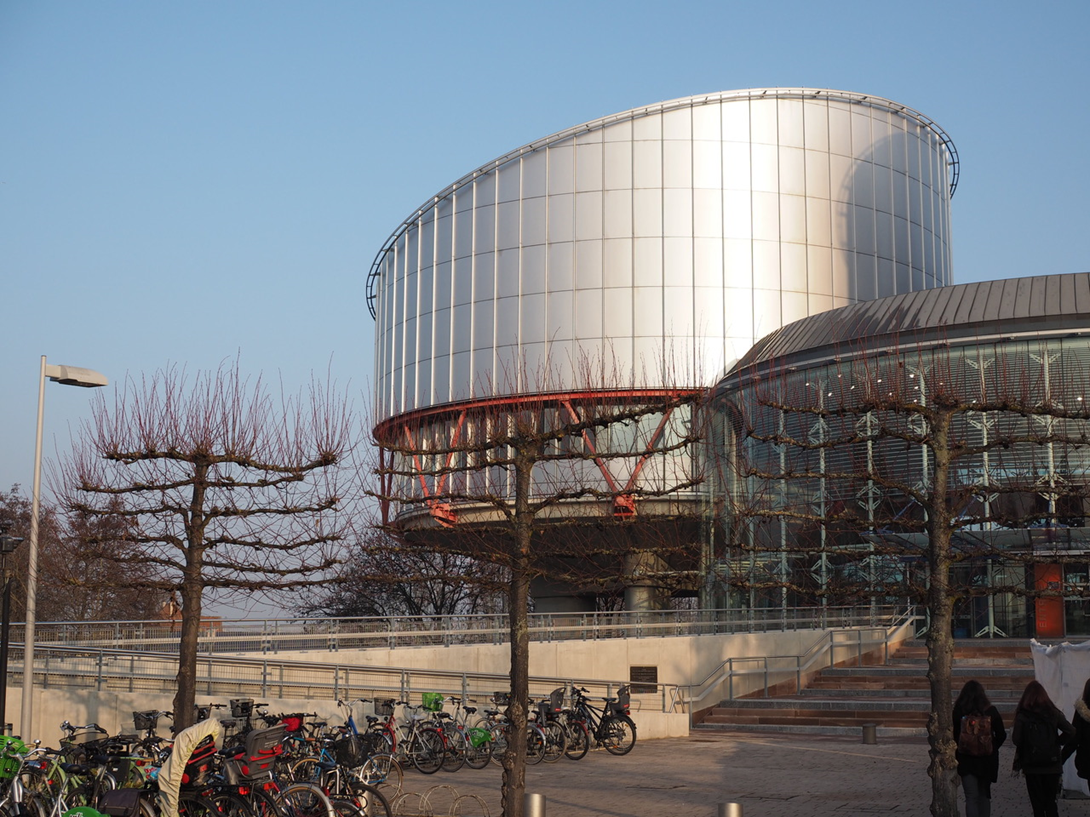
Credits: Antenor Hallo de Wolf
An interview with Dr. Eleni Micha on submitting an application in front of the ECtHR
By Niloufar Fasli and Lena Marie Neuhaus
In the context of the course International Human Rights Law in Practice for our LL.M. International Human Rights Law at the University of Groningen we had the chance to interview Dr. Eleni Micha on the matter of submitting an application before the European Court of Human Rights (ECtHR).

Dr. Eleni Micha holds a teaching position at the Department of International Studies at the Faculty of Law of the University of Athens and is Visiting Lecturer at Frederick University in Cyprus. She holds a PhD in Law from the University of Athens, with additional studies at Leiden University and a diploma from the International Committee of the Red Cross’s Legal Department for an outstanding article on international humanitarian law. Her expertise includes human rights protection, humanitarian law, and international criminal law. She teaches at the University of Athens and practices law with a focus on human rights. Dr. Micha has published widely and contributed to legal commentaries, including on the European Convention on Human Rights (ECHR). Dr. Micha was the legal counsel and one of the applicants in the case Micha and others v. Greece, issued by the ECtHR on 8 October 2024.
The interview featured here is an excerpt from a more extensive interview conducted with Eleni Micha.
Dr. Eleni Micha, to start off this interview, what challenges should an applicant keep in mind before submitting an application to the ECtHR?
What every applicant and lawyer should keep in mind as the most significant challenge in bringing a case before the ECtHR is establishing the jurisdiction of the Court and, especially if we move further from the jurisdiction obstacle, fulfilling the admissibility requirements.
Being a victim, a direct or indirect one, depends on the facts of the case. Even if your client considers themselves to be a victim, sometimes, this might not be the case, according to the ECtHR’s case law.
The exhaustion of domestic remedies is also a complex issue. What are the domestic remedies in every State? You have to be familiar with the system of domestic remedies and check whether they are available in practice. For example, I had a difficult case, which was meant to fail from the outset, because it was a very weak case in this respect. The case was against Switzerland, and it was a family case. Given its complexity, an entire team of lawyers were involved therein. We had to look into the domestic remedies provided by the Swiss legislation and whether they were exhausted. In this context, we contacted not only the domestic authorities, but also research institutes with a view to get clarity on how the system works there. The exhaustion of domestic remedies is one of the main issues to look into in every individual case. There is also the fact that the time limit for filing an application which is now reduced to four months, that makes it an additional point of attention. You have to be aware of it and diligently check your calendar.
Do you believe that ECtHR judgements have a positive impact and can improve human rights issues? If yes, could you mention specific cases that have had particularly relevant outcomes?
I have a lot of cases in my mind and we can cite a few. Of course, ECtHR judgments have a positive impact, and they have done so for many years. They truly changed features of the domestic systems within the CoE Member States.
The impact, for example, on the educational system in the United Kingdom is telling. When the Court held, a very long time ago, in the famous case of Campbell and Cosans that corporal punishment in British schools was incompatible with the European Convention on Human Rights, the United Kingdom was obliged to modify its legislation. And that happened for many Member States. And in our case, of course, in Greece, there has been a tremendous change of legislation in recent years regarding, especially, trial rights and the length of proceedings for the delivering of judgments within reasonable time. That was a huge development for the Greek legal order (see Vasileios Athanasiou and others v Greece and Glykatzi v Greece, but also recent developments with Vervele v. Greece).
I could also cite some other cases that I found extremely interesting. For many Member States, such as Cyprus and the United Kingdom, the abolition of domestic legislation on characterising homosexuality as a crime occurred further to a number of ECtHR judgments. Such was the case in Modinos v Cyprus. Up until then, homosexuality was considered a bar for certain professions. For example, being a member of the armed forces of the country as it was ruled in Lustig-Prean and Beckett v. UK, a very interesting and groundbreaking case.
A more recent example pertains to the jurisdiction of the Court and the expansion of the scope of Article 1 ECHR. I am referring to the case of Carter v Russia, about the death of a Russian agent, outside of Russia, who was poisoned by the Russian authorities. The list is ongoing, and any attempt to indicatively cite groundbreaking cases, makes little justice to the ECtHR.
You were one of the applicants and the legal counsel for Micha v. Greece. Can you tell us what was special about this case and how you experienced both roles?
The heart of the problem in our case was the refusal of the administrative authorities, both local and regional, to comply with the judgments of the Greek Supreme Administrative Court and lift the restrictions concerning the use of our land following a series of expropriation decisions that have blocked the plots of land for over 20 years. The special feature of this case lies in the lack of domestic remedies to compel the domestic authorities to lift these restrictions and issue a building permit we have asked for or pay a fair compensation in case the competent authorities would proceed with the expropriation process. So, this case was characteristic not just because the applicants’ property rights had been violated but because there was a combined violation of our fair trial rights and property rights. For the European Court, which accepted our argumentation, such a situation was part of a long-standing problem for Greece that could be solved if the national authorities took those individual measures, we have proposed them. Such measures are the ones undertaken in similar cases under the supervision of the Committee of Ministers at the execution stage.
To be a victim and the legal counsel in this case was a challenge for me because I had to keep the balance between a lawyer’s professional conduct by examining the strengths and weaknesses of the case to provide objective advice to the other applicants, and at the same time, not to lose my focus due to my personal interest as an applicant. The fact that I was aware of the progress of the case from the very beginning, along with the gaps in the Greek administrative practice regarding the expropriation process, made my task easier in developing a persuasive strategy before the European Court.
What are your expectations and hopes for the future concerning the ECtHR and its function?
There is a lot of things to discuss about the function of the Court and its future. The European Court, as all international courts, needs state cooperation in order to achieve the best results for human rights protection. The crucial thing for me is to shape bonds and build confidence between the Court and the Member States, especially the latter’s agents and the public officials. These are the ones that are called upon to apply the European Convention on the ground. There is no use in having the European Convention and Strasbourg case-law written down without the state officials being able to know what is happening in practice, what the ECtHR has held, why it matters, and how they can carry out the individual measures provided by the Court. This is, if I may say so, a state of confidence and knowledge between the two sides. Also, a more comprehensive dissemination among the different branches of government is useful. And, of course, implementing domestic legislation where and when there is such suitable domestic legislation.
In most cases, legislative changes are not necessary. At least not in most European Union Member States. Even if domestic legislation is fragmented, it still exists. It therefore needs to be implemented. And, in the end, of course, as the ECtHR itself has stated, strengthening the judicial dialogue between the courts of the different CoE Member States and the ECtHR is crucial. Finding a violation is an opportunity, after all; it is not just about ‘condemning’ the Member State as an ‘enemy’ state, a violator of human rights. States should see this as an opportunity for correcting their own shortcomings in their own house. Our State is our household. So, you must keep, as professor M. Matheson once said, your own house clean. That's the idea. It's not about somebody in Strasbourg who opened the files wanting to punish States or people. States ought better to use the finding of a violation as an opportunity to consider seriously the gaps in their domestic legal order regarding human rights and solve their own problems.
Bios:
Lena Marie Neuhaus is a graduate in Law at the University of Nice Cote d’Azur and Saarbrücken and pursued an LL.M. in International Human Rights Law at the University of Groningen. Now she is doing a second Master’s in European Economic and Financial Criminal Law in Luxembourg.

Niloufar Fasli
Niloufar Fasli is a graduate in Law from the University of Derby. She is now pursuing an LL.M. in International Human Rights Law at the University of Groningen.