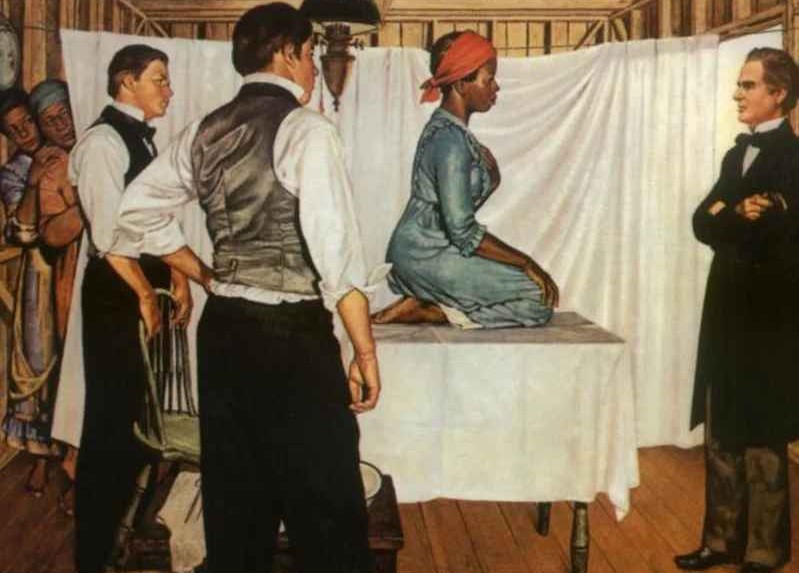
Credits: J. Marion Sims: Gynecologic Surgeon (1952) by Robert Thom. Part of the "Great Moments in Medicine" series commissioned by Parke-Davis.
This entry is part of the EQUALS Conference Blog Series: Challenging Health Inequalities in a Digitalised World
1. Introduction to the Blog symposium: Challenging health inequalities in a digitalised world
By Tina Stavrinaki
A platform for equality legal studies
EQUALS, the Research Platform on Equality Legal Studies at Utrecht University’s School of Law, explores how the law shapes inequalities and discrimination and how law can serve as a tool for a fairer society. For its inaugural seminar on 24 February 2026, EQUALS brought together a diverse group of scholars to rethink health systems and focus on those who have been left out. Karin de Vries, who coordinates the platform with Lorena Sosa, opened the seminar, followed by three panels. The first panel focused on the determinants of health inequality, the second one on sexual and reproductive health rights and family law and the third one on the role of institutions. This symposium brings together a selection of contributions from academia and practice in the Netherlands, the United Kingdom and the United States.
Health systems and structural inequalities
The seminar started from the premise that Inequalities are structurally produced, through patterns of separation, othering and devaluation that determine who is recognised within public health systems and who is not.
2026 marks sixty years since the adoption of the International Covenant on Economic, Social and Cultural Rights (ICESCR), ratified by the overwhelming majority of States, including every EU Member State, promising equality in the enjoyment of the right to the highest attainable standard of physical and mental health under Articles 12 and 2 para. 2. The prohibition of discrimination is an immediate obligation (General Comment No. 14, paras 18 and 30; General Comment No. 20, para. 7). The International Convention on the Elimination of All Forms of Racial Discrimination (ICERD) goes further, combining formal equality with a demand for special measures to dismantle structural inequality (Articles 1(4), 2(2) and 5(e)(iv); General Recommendation No. 32; General Recommendation No. 37, paras. 10-11). Similarly, the Convention on the Elimination of All Forms of Discrimination against Women (CEDAW) requires States to identify, eliminate and remedy discriminatory stereotypes and systemic patterns of inferiority (Articles 2(f), 5(a) and 12; General Recommendations No. 24 and No. 25).
2026 also marks twenty years since the decision in the collective complaint Marangopoulos Foundation for Human Rights v. Greece where the European Committee of Social Rights recognised, in 2006, that the right to a healthy environment is inherent in the right to health under the Charter (decision on the merits, para. 195). Brought under Article 11 of the European Social Charter, the case showed how a national energy policy, failing to prevent (e.g. by morbidity studies), mitigate (e.g. by regular health tests, campaigns and participatory consultations with the affected communities) and remedy the environmental and health burdens on workers and residents in the area in forty-five years of exploitation breached the right to health. The case is a clear example on how health inequalities are constructed through what the World Health Organization conceptualises as the social determinants of health. Those determinants are not randomly produced. They are supported by laws, institutions, commercial (f)actors and cultural norms shaping societies and health systems. Racism, classism, sexism, ableism, xenophobia, homophobia and transphobia determine the allocation of resources, health risks and protection.
Law is central to these patterns through underrepresentation in decision-making, gaps, fragmentation, inadequate translation of legal obligations into policy and medical education. Law is not applied in a historical vacuum. Interference with bodily autonomy through policies and unclear protocols has operated as a form of control: from the coercive sterilisation of Indigenous, Roma and disabled women (see, for example CEDAW’s views in A.S. v. Hungary and the Inter-American Court’s judgment in I.V. v. Bolivia), to coercive practices in mental health targeting People of African descent and other disadvantaged groups. Life expectancy gaps mirror indirect discrimination in prevention and overexposure to health-harming conditions, such as for Aboriginal and Torres Strait Islander peoples in Australia and Roma populations in the EU, with the FRA Roma Survey 2024 indicating that the EU’s 2030 target is unlikely to be met.
No country is immune to gaps and bias in sexual and reproductive health rights. In her piece “All that glitters is not gold”, Liliane Ploumen focuses on the Netherlands and argues that while its reputation for protecting those rights is largely deserved, access in law has not translated in equal access for all. The post, in alignment with World Health Organisation, argues that abortion should be governed by health law like any other case, and not through the Criminal Code.
Neither law nor medicine is a neutral space of knowledge and epistemic inequality is one of the forms that discrimination in health takes. Parts of modern gynaecology were developed through surgeries without anaesthesia on enslaved Black women: between 1845 and 1849, Anarcha, Lucy and Betsy endured dozens of them. Race-based stereotyping in medical training and false beliefs about biological differences in pain tolerance continue to produce misdiagnosis and under-treatment. Research shows that women of African descent in high-income countries face significantly higher risks of pregnancy-related death, even after accounting for education. For example, the latest MBRRACE-UK data show a risk nearly three times that of the dominant population of women.
Turning to the EU level, Rachel Horton confirms gender as structural determinant of health, drawing on a report co-authored with Tamara Hervey for the European Commission. In her post, “Gender inequality in access to healthcare: the role of the EU equality law”, Rachel maps how gender structurally shapes access to healthcare and concludes that the Goods and Services directive, case law and enforcement action fail to address these gaps. As a way forward, she advocates for positive duties and gender mainstreaming in designing the health services, research and training.
In “Batten down the hatches. Protecting the right to health as AI scales up”, Leigh Haynes, focuses on the obligation to protect against disruptive technological change. She warns against prediction models that do not satisfy the requirements of quality of care, contain and aggravate bias, while exacerbating the blurring between disease detection and policing. Leigh Haynes recommends a human-rights based approach beyond what the EU AI Act demands.
Read together, the three posts converge. Inequality in health is produced and sustained by frameworks that treat one kind of care as exceptional, by legal regimes that partially address individual acts while leaving research and coordination gaps untouched and by technical systems whose discriminatory effects have never been assessed.
Dismantle inequalities and advance equality
The good news is that dismantling inequalities improves health outcomes across the society. Advancing equality is not a choice, but a legal obligation requiring a strategy of interconnected measures on: i) measuring inequalities through disaggregated data, based on a self-identification and within an intersectional framework; ii) preventing the role of determinants at an early stage; iii) addressing bias and epistemic inequalities within the health systems, including in clinical trials and algorithmic design; iv) “looking to the bottom”, in Mari Matsuda’s phrase, by co-designing policies with those with the lived experience of discrimination and oppression; v) bringing transformative change, through structural remedies, preventing recurrence and building trust with the affected communities.
That is what EQUALS was founded to enable: rethinking law, institutions and policies by placing at their centre those long excluded from them.
Bio

Dr. Tina Stavrinaki Assistant Professor of Human Rights and International Law at the Netherlands Institute for Human Rights (SIM) and the Department of International and European Law, and a researcher at RENFORCE and EQUALS . She serves as elected member at the UN Committee on the Elimination of Racial Discrimination (CERD), where she coordinates the working group on individual complaints. From 2022 to 2024, she was Vice-Chair of the Committee and rapporteur for the General Recommendation on Racial Discrimination and the Right to Health .