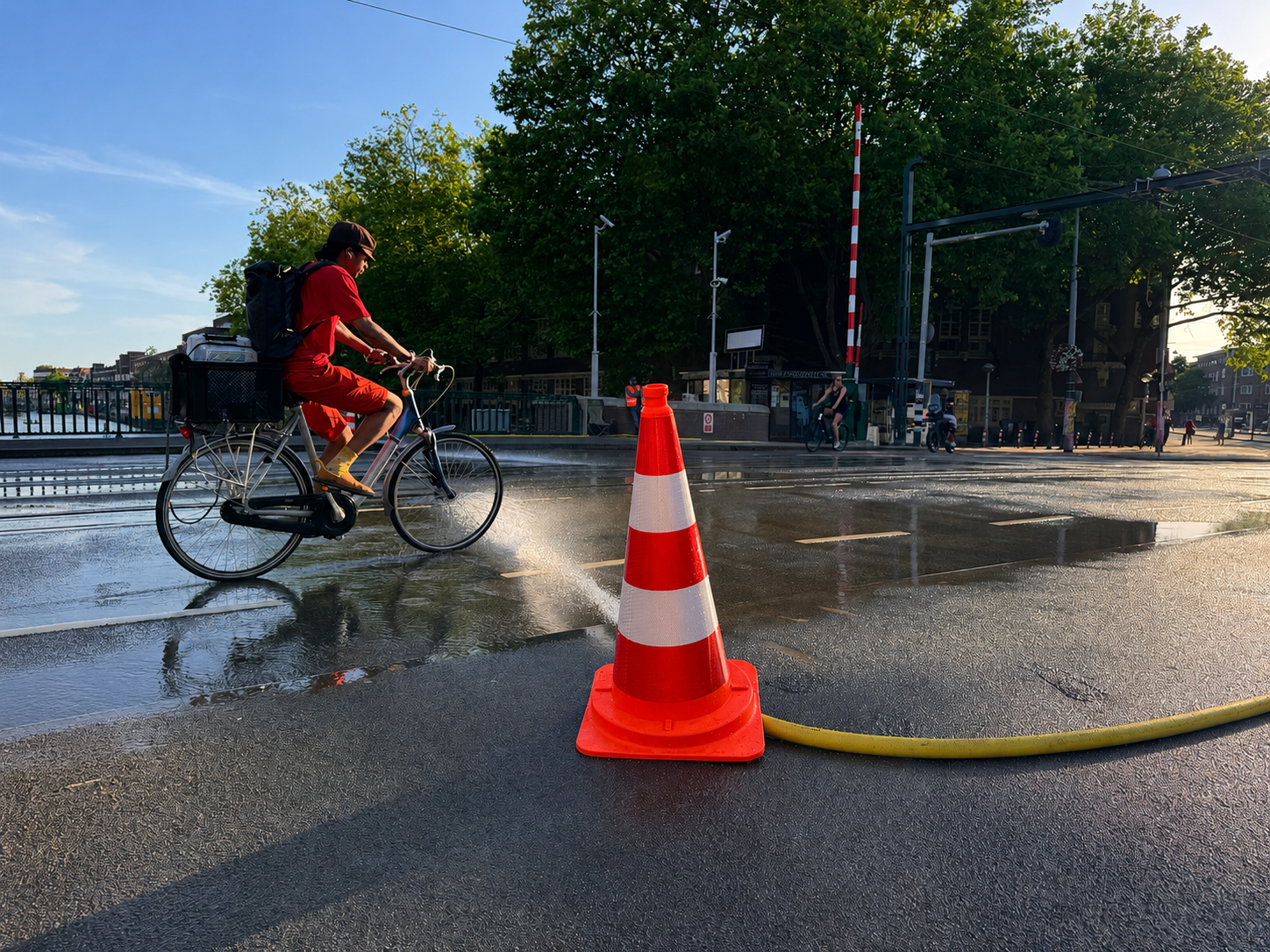
Credits: Cooling the bridge during the heat, Amsterdam, 2026 Photographer: Stichting CAS
By Samuel Ballin (Radboud Universiteit); Julie Fraser (Universiteit Utrecht); Anneloes Kuiper-Slendebroek (Universiteit Utrecht); Phoebe Muir (Rijksuniversiteit Groningen); David Patterson (Rijksuniversiteit Groningen); Patricio Trincado Vera (Rijksuniversiteit Groningen)
Introduction
This blog post describes a July 2026 review of the draft Dutch National Climate Adaptation Strategy 2026 (NAS’26) by members of the NNHRR human rights and climate change working group. In undertaking this review, we sought to explore how a human rights-based approach can strengthen state responses to climate change – both adaptation and mitigation. More broadly, the review demonstrates how human rights scholars and other advocates for human rights-based approaches can participate in strengthening national and subnational responses to economic and social challenges. Notably, the draft NAS’26 makes no reference whatsoever to applicable human rights law. The post therefore concludes with a call for greater teaching and awareness of human rights law in Dutch schools and universities.
Background
The draft NAS’26 was published in Dutch and English for public review and comment on 9 June, with responses due some five weeks later. In his Foreword to the draft NAS’26, the Dutch Minister of Infrastructure and Management, Vincent Karremans, noted that the Netherlands’ mainland and its territories, ‘…are perfectly safe because our water defences are among the most advanced in the world and because we continue to adapt to changing conditions…’. Yet both the European and Caribbean territories of the Netherlands are increasingly subject to greater air and water temperatures, increased storm frequency and severity, and sea level rise. These events will worsen as climate change continues. The Dutch government has legal obligations to help communities adapt, build resilience, and relocate if necessary.
Human rights-based approach
Following the 2012 guidance of John Knox (para. 17), the then UN independent expert on the issue of human rights obligations relating to the enjoyment of a safe, clean, healthy, and sustainable environment, we are interested in both the substantive and procedural elements of the draft NAS’26. Thus, in addition to reviewing the content, we ask how affected communities were involved in the development of NAS’26.
Content
The draft NAS’26 does not refer to human rights at all – neither international, regional (European Convention on Human Rights (ECHR)) nor national obligations, despite referring to other applicable international treaties such as the Paris Agreement. Therefore, the NNHRR review first sets out the applicable law under the ECHR, and national (Urgenda (2019), Bonaire (2026)) and regional (Klimaseniorinnen (2024)) case law under ECHR Article 2 (right to life) and Article 8 (right to private life). Human rights must be observed not only at the national policy level in NAS’26, but also at the local level, where many of the implementation responsibilities will lie. However, no related guidelines or references are provided by the NAS’26. Therefore, we made suggestions throughout the document, including the establishment of a ‘climate fund’ for climate measures taken by local governments.
The review emphasises the role of evolving scientific evidence and hence of state obligations. However, instead of obligations, the draft NAS’26 refers to ‘goals’. For example, while the draft NAS’26 acknowledges the acute danger of heatwaves (‘improving risk perception’, ‘making cities heat resilient’) it misses specific, binding and quantified targets, such as mandatory maximum temperature thresholds for public housing, hospitals and schools, as well as concrete deadlines by which these standards must be achieved. This approach contrasts with the strict, legally binding emission-reduction targets of the Dutch Climate Act. Instead, our review stresses that climate change mitigation and adaptation must go hand in hand. Furthermore, the review urges the provision of a legal mechanism that allows individuals or vulnerable groups to hold public authorities legally accountable if (local) adaptation measures fail to meet the ‘effective protection’ standard discussed in Klimaseniorinnen.
The review then moves from the European regional framework to the applicable international law, including human rights law, identified by the International Court of Justice in its 2025 Advisory Opinion on Climate Change. The review considers applicable decisions relating to adaptation, including Teitiota (2020) and Billy (2023), and states’ obligations regarding the right to health and the guidance of UN Committees. Once again, no guidance is provided by the NAS’26 for those who will implement the policy, namely local governments.
The review notes that NAS’26 deserves credit for recognizing that climate change is not merely a physical threat, but also a psychological one. For example, extreme flooding (such as in Limburg in 2021 and Enschede in 2024) resulted in severe long-term stress, anxiety, and trauma, which are exacerbated by post-disaster financial and legal issues, and the fear of recurrence. However, reference to spiritual health is completely missing in the draft NAS’26. For some people in the Netherlands, health is inextricably linked to spiritual and cultural well-being, particularly in relation to the natural environment and ancestral lands. The omission of spiritual health is particularly damaging to the populations of Caribbean Netherlands (Bonaire, Saba, and St. Eustatius).
By failing to address how environmental degradation impacts the spiritual practices, identity, and cultural heritage of its Caribbean citizens, our review notes that the Dutch state falls short of its obligations under ICESCR Article 12 (right to health), Article 15 (the right to participate in cultural life), and ICCPR Article 27 (the protection of minority cultural rights). The NAS’26 approach appears to reflect a model of health that fails to treat humans as holistic, culturally-situated beings.
The review notes that NAS’26 is framed as a ‘voluntary national programme’. However, health cannot be protected adequately by discretionary, fragmented local policies. Finally, the review considers how climate adaptation measures must meet the needs of vulnerable groups, such as women and girls, children and people with disabilities.
Process
While the NAS’26 laudably mentioned consultations with civil society ‘sounding board groups’ and research among young people, it did not distinguish children as a separate group for consultation. However, child-friendly participation is a particularly pertinent issue for children, who will face the brunt of climate change impacts in the future, but in the present are unable to exert influence on climate policy decisions through participation in formal democratic processes. Such consultation should be accessible to children from disadvantaged groups, children with disabilities, children from minority groups, and children living in vulnerable areas. As a practical measure, the review suggested that the Dutch government could consider including schools and local youth groups in adaptation planning. This would also increase access for children from different backgrounds.
NNHRR recommendations on the draft NAS’26
The review offers nine succinct recommendations for the revision and strengthening of NAS’26. These relate variously to ensuring that mitigation and adaptation planning are coordinated and funded; that vulnerable communities, including those of faith, migrant and marginalised communities, are consulted meaningfully, and that gender balance is maintained in relevant decision-making bodies; that local authorities have adequate funding to undertake identified measures; and that climate-resilient health systems are strengthened, including to address the needs of women and girls and other vulnerable groups.
Conclusion
Concurrent with the publication of the National Adaptation Strategy (NAS), the Ministry of Infrastructure and Management has committed to publishing a ‘Response Memorandum’ (Reactienota) containing responses to all the views submitted. This process is to be commended.
Thinking more broadly, perhaps the Ministry simply lacks the inhouse capacity to routinely bring a human rights lens to its work on climate change and other areas. For local policymakers, human rights often remain an abstract concept that feels far removed from their daily reality, or one that is conflicting with domestic legal obligations. However, (emerging) climate obligations clearly demonstrate that human rights should be top of mind from the outset. This points to a failing in the Dutch legal education system. International human rights law is not a compulsory subject in Dutch undergraduate law programs. It might get a mention in courses on public international law or in elective modules on human rights’ topics that might seem far removed from daily reality – the right to life, fair process, to be free from torture. But because human rights should be ‘daily business’ and permeate all areas of governance, law and public administration, it should be at the heart of legal education. The 2025 ICJ advisory opinion and the ECtHR in KlimaSeniorinnen have both affirmed the applicability of international and regional human rights frameworks, respectively, to climate change. Surely every Dutch law graduate should be aware of these obligations – whether they then proceed to work for the government, for the private sector, or in a civil society organisation? There are some moves to integrate climate change into Dutch legal research and education (Smeehuijzen & Sauter, 2026; VU (course) (law clinic); Seven - Verdict; GCHL), but much more must be done to graduate climate conscious lawyers, and swiftly.
Bio

Samuel Ballin (they/he) is a PhD candidate at the Centre for Migration Law at Radboud University. Their PhD research applies a climate mobility justice lens to the vulnerabilities and mobilities of highly qualified third-country national migrant workers and the (un)responsiveness of EU law. They are a member of the NNHRR Working Group on Human Rights and the Climate Crisis and the Working Group on Migration and Borders.

Julie Fraser is a human rights scholar and lawyer working at The Netherlands Institute of Human Rights at Utrecht University. She is presently one of the leaders of the NNHRR Working Group on Human Rights and the Climate Crisis.

Anneloes Kuiper is Assistant Professor of International and European Liability Law at the University of Utrecht, and co-director of the Master’s programme in Private Law. Her research focuses on the interaction between international (human) rights law and national legal practice. She is a member of the NNHRR Working Group on Human Rights and the Climate Crisis.

Phoebe Muir (LLM) is a PhD candidate at the Department of Transboundary Legal Studies and the Groningen Center for Energy Law and Sustainability, at the University of Groningen. Her research focuses on mapping youth-led climate litigation around the world, as well as examining how these cases spur legal and societal adaptation to climate change. Her project is interdisciplinary, combining legal research, socio-legal empirical research, and rhetorical studies. She is a member of NNHRR Working Group on Human Rights and the Climate Crisis.

David Patterson, PhD, is a researcher at the Groningen Centre for Health Law, University of Groningen, President of the Law and Public Health Section of the European Public Health Association (EUPHA), and a member of NNHRR Working Group on Human Rights and the Climate Crisis. He researches and advocates for urgent human rights-based climate action.

Patricio Trinccado Vera (he/him) is a PhD candidate at the Transboundary Legal Studies Department at the University of Groningen. His research focuses on developing a decolonial approach to the Right to a Healthy Environment to address the issue of lithium extraction in the Chilean Atacama salt flat. He is also part of the Groningen Centre for Health Law and a co-coordinator of the Working Group on Human Rights & the Climate Crisis of the Netherlands Network for Human Rights Research.