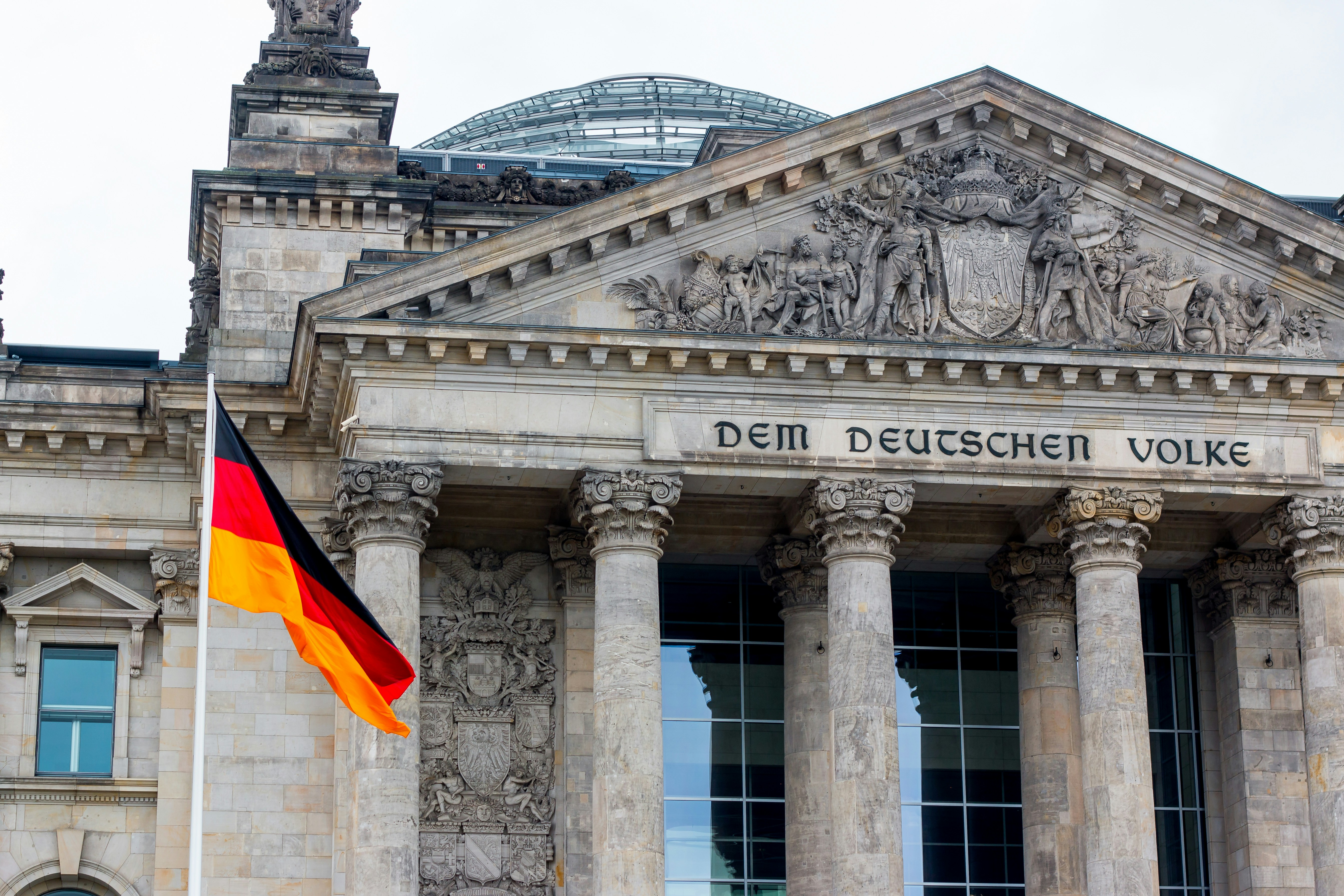
Credits: Rasmus Gundorff Sæderup via Unsplash.
In March 2026, German economic institutes found that the German government had used a special fund, constitutionally earmarked for investments into infrastructure and climate neutrality, almost entirely for other purposes. This ‘misuse’ is not only politically controversial: I argue that human rights obligations, as interpreted by the German Constitutional Court (‘BVerfG’) and regional and international jurisprudence, might require not only legal correction of misallocated spending, but also the subsequent investment of the available funds into climate protection.
The German Schuldenbremse and its 2025 Reform
The special fund was created as an exception to the German Schuldenbremse, a constitutionally anchored debt brake. The Schuldenbremse limits the amount of additional borrowing by federal and state governments. Economically liberal parties such as the FDP and the CDU/CSU argue that this system promotes intergenerational equity, security, and trust. However, it remains criticised because of the restricted flexibility in responding to economic and societal needs (as evident during the COVID-19 pandemic). Critics, including the Left party and the German Trade Union Confederation, also argue that it slows public investment and social policy, and forces public spending cuts. Even from a purely economic perspective, the system has been criticised to limit growth. Consequently, there have been many calls to do away with the system.
Instead of abolishing it, the German Parliament reformed the Schuldenbremse in March 2025. The SPD and CDU/CSU together proposed amending the Constitution, mainly to enable increased military spending. However, the proposal also introduced Article 143h, which would enable establishing a special fund of up to 500 billion euros for “additional investments into infrastructure” via loans exempted from the debt brake. The final version of the proposal also enabled usage of the fund for investments into climate neutrality. Moreover, another 100 billion euros were earmarked to be allocated to the Climate and Transformation Fund (‘KTF’).
Importantly, Article 143h GG does not create new obligations: Firstly, the climate neutrality objective is already set out in the Federal Climate Law (‘KSG’), and the BVerfG confirmed the constitutional duty to protect from climate change in its 2021 Neubauer judgment. Secondly, Article 143h does not oblige to actually invest money, only creating the possibility for it.
However, one central conclusion remains: if the legislator borrows money to establish this special fund based on Article 143h GG, this money is purpose-bound: it can only be used for investments into infrastructure or climate neutrality (see here and here).
The BVerfG’s Confirmation of the Purpose-Bound Nature of Special Funds
This conclusion is also supported by a BVerfG Order of 2023, concerning a special fund for the COVID-19 response, established by law and based on the debt brake’s emergency exception. As it became clear that the money from the COVID emergency fund was not needed for its original purpose, the Government adopted a second legal act with retroactive application transferring the remaining funds to the KTF. Members of Parliament requested abstract judicial review of the second act, arguing that the retroactive transfer of purpose-bound special funds is unconstitutional. The BVerfG agreed, confirming that a “decoupling of the credit authorisation from the actual use of the funds […] is not constitutionally permissible”. Consequently, the second legal act was voided and wrongful expenses had to be compensated otherwise.
‘Misuse’ of the Special Fund
This brings us to March 2026, where news outlets reported on the apparent ‘misuse’ of the infrastructure and climate fund. They cited independent research reports from two reputable German economic institutes, the Institute for Economic Research (‘IFO’) and the Institut der deutschen Wirtschaft (‘IW’). The reports highlighted two central findings: First, while Germany acquired around 24,3 billion euros of extra debt in 2025, additional investments only amounted to 1,3 billion euros. Second, of the 19 billion euros previously allocated for additional investments, only 2 billion euros were invested, while another 12 billion were spent on miscellaneous expenses traditionally covered by the core budget. Consequently, 86-95% of the special fund were ‘misused’.
This revelation caused heated debate. While German Minister of Finance rejected the accusations, citing the delayed implementation of the 2025 budget and the late adoption of the implementing law as reasons for the slow spending, members of the CDU/CSU hinted at the need to revise the “rules of the special asset”.
A Reflection on the Potential (Legal) Consequences
While this discovery is clearly controversial, what might be concrete (legal) consequences?
First, while the legitimacy of the findings is questioned due to conceptual uncertainty around the term ‘additional investments’ and the delayed implementation of the special fund, this should not pose any hurdles. It is true that no definite clarity exists on what can be considered ‘additional investments’. However, it is clear that there is a discrepancy between money allocated for new investments and money actually invested, as well as between extra debt and money actually spent on expenses outside the core budget. While the implementation delay might explain the limited additional investments, it neither explains nor justifies that the special fund was established by allocating additional investments into infrastructure and climate, but then mostly used for miscellaneous expenses that were not investments into infrastructure or climate.
Second, the question of legal avenues remains. The 2023 BVerfG Order on the COVID-19 fund was the consequence of an abstract judicial review request initiated by members of the German Parliament based on Art. 94(1)(2) GG. Such review can, however, only concern a legal act, not its execution. As the most recent misuse had not taken place by law, this avenue seems impossible.
This leads us to the potential of an individual constitutional complaint, based on Art. 94(1)(4)(a) GG. Based on BVerfG jurisprudence, an individual constitutional complaint requires a complainant that is themselves, currently, and immediately affected in their constitutional right(s). Some academics argue that this route would fail due to the lack of a constitutional obligation to execute budgetary planning or planned fund allocation. In the hypothetical scenario that the Government had not taken out any additional loans, this argumentation would hold. However, in this case, the Government had taken additional loans via Article 143h GG, only possible through the allocation of money for additional investments into infrastructure or climate, but mostly failed to use it for its constitutionally specified purpose(s).
Given this factual situation, a constitutional complaint alleging the violation of a constitutional duty – Article 143h GG – together with the intertemporal freedom guarantee doctrine à la Neubauer – based on Article 20a GG (see here or here) – might be plausible: the failure to invest into a climate-neutral future today, despite the availability of funds constitutionally allocated for this purpose, violates fundamental rights, such as the right to life, bodily integrity, property, or occupational freedom, specifically of young people and future generations, as it shifts burdens disproportionally onto them.
In this way, it might be possible to argue not only that wrongfully covered by the special fund must be compensated by other means, but also that the Government is now obliged to spend the now-available money specifically for the purpose of climate protection. This argumentation would further resonate with recent national, regional, and international jurisprudence and is made even more salient with evidence of serious shortcomings of German climate action:
First, next to the BVerfG’s Neubauer Decision, the European Court of Human Right’s KlimaSeniorinnen judgment, and the Advisory Opinion of the International Court of Justice, have recently clarified and reminded of the responsibilities of States in mitigating the climate crisis.
Second, recent reports from the German Environmental Agency, the German Advisory Council on the Environment, or the German Council of Experts on Climate Matters (‘ERK’) highlighted that Germany will likely fail to meet its 2030 emission reduction target. Implementation shortcomings have also been confirmed by the Higher Administrative Court Berlin-Brandenburg in 2023 and the Federal Administrative Court in 2026. Both courts highlighted the need for a revision of German climate action. As a consequence, the Government adopted a new climate protection programme in March 2026, wherein an additional 8 billion euros are allocated to implement necessary measures. However, the ERK also declared this new programme as likely insufficient to meet various climate targets, and criticised specifically the lack of effective measures for the buildings and transport sector.
Third, the lack of climate ambition is currently challenged again in several pending constitutional complaints (see Neubauer et al. or Recktenwald et al.). Here, the complainants cite, among other things, the failure to make necessary investments, for example into public transport and e-mobility, as a violation of their constitutional rights.
This factual and legal context enables the evident diagnosis: German must urgently take more effective climate action due to clear and binding national, regional, and international obligations and evident implementation shortcomings. This will require additional investments into climate protection as well as infrastructure. And, evidently, there seems to be money available from funds already constitutionally earmarked for these purposes.....
Bio
Tessa Trapp is a PhD Researcher at Amsterdam Centre for European Law and Governance (ACELG) at the University of Amsterdam, researching the role of storytelling in European climate litigation. Her other research interests include European and national developments on climate and environmental law.