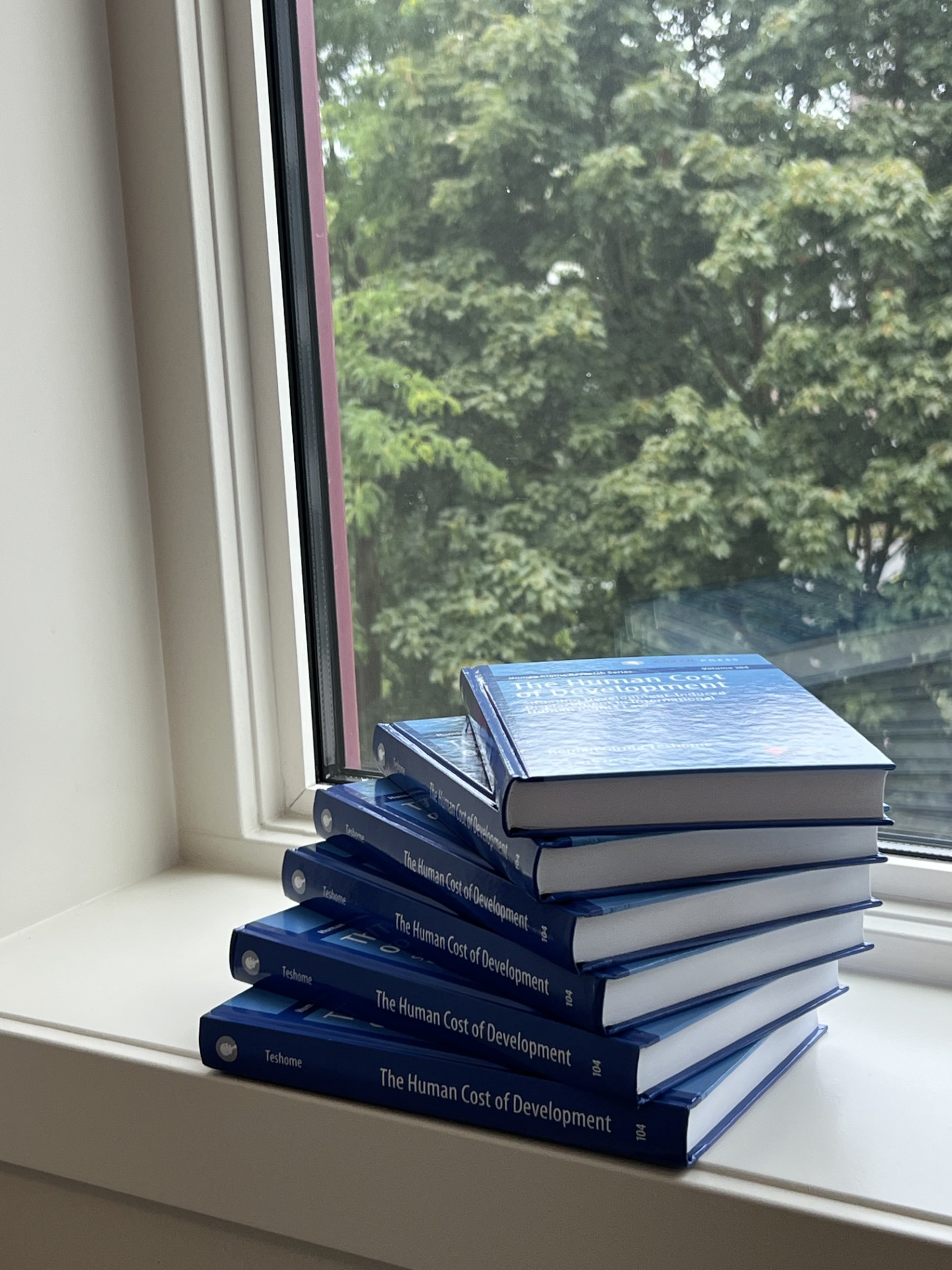
On the occasion of the publication of the first book in the reinvigorated Human Rights Research Series, Estephany Leon Rodriguez and Marianna Peroni, research interns at the T.M.C. Asser Institute, interviewed Christophe Paulussen (senior researcher, strand coordinator and former acting academic director at the T.M.C. Asser Instituut); Antoine Buyse (Director of the Netherlands Institute for Advanced Study (NIAS) of the Royal Netherlands Academy of Arts and Sciences (KNAW) and Chair (full professor) of human rights from a multidisciplinary perspective at Utrecht University); Nicola Jägers (Professor of Human Rights Law at Tilburg University); and Yvonne Donders (Professor of International Human Rights and Cultural Diversity at the University of Amsterdam and member of the UN Human Rights Committee) about their experiences with the Series. All four were among the early authors to publish their thesis in the NNHRR Human Rights Research Series.
The Human Rights Research Series offers leading scholarship on the evolving landscape of international human rights norms and their practical implementation. This collection explores the complex interplay between global standards and national legal frameworks, examining how human rights principles are interpreted, applied, and enforced across diverse contexts. Authored by NNHRR members, each volume in this series provides an in-depth analysis of critical issues at the intersection of law, policy, and human rights advocacy. The series encompasses a wide range of methodological approaches, from rigorous doctrinal analysis to innovative empirical studies, reflecting the multidisciplinary nature of human rights research. This series serves as an essential resource for academics, policymakers, legal practitioners, and human rights defenders seeking to deepen their understanding of contemporary human rights challenges. By bridging theoretical insights with practical applications, these books contribute to ongoing debates about the role of human rights in shaping just and equitable societies. The Human Rights Research Series aims to foster dialogue, inspire innovative approaches, and ultimately advance the protection and promotion of human rights at both the national and international levels.
CHRISTOPHE PAULUSSEN
You were among the early authors to publish your thesis in the NNHRR Human Rights Research Series, namely Volume 41. What do you remember about the experience of publishing your dissertation in the series at that time?
I remember spending a lot of time making sure the book, once it was written, was ready for publication. That my manuscript was quite lengthy [laughs a bit (Christophe’s PhD counts 1195 pages)] didn’t help… While I had good contact with Intersentia (the publisher of the School of Human Rights Research Series, the forerunner of the current series) they could not give the necessary support in making the manuscript print-ready, except by providing us, the authors, with all the requirements. In that sense, they only pressed the ‘print’ button – we had to do everything else ourselves. This experience introduced me to the wonderful world of typesetting, which luckily, I have not had to wander again ever since.
How did publishing your thesis in the NNHRR series contribute to your academic career or research trajectory?
I am not sure to be honest to what extent publishing in the specific series has contributed to my academic career. In the end, the quality of the manuscript, wherever it is published, will probably be more relevant. However, I definitely liked publishing my PhD in a series in which many of my generation’s scholars working on human rights have published their PhDs as well. In a way, it makes your PhD research become part of something bigger.
From your perspective, how has Dutch human rights academia changed over the years?
Although this is not limited to the Dutch context, it is with sadness that I see that international (human rights) law is increasingly being undermined by states. This also has an effect on how the academic world engages with the world of practice. If governments are not respecting the most basic rules of international law, then other societal actors, including academics, have a responsibility to step up even more to explain why international law was developed in the first place, why we need it and why undermining it will backfire in the long run. Luckily, I also see an increased determination from the side of academia to take up this responsibility. At the same time, our credibility as objective societal players is vital. Hence, academics must always work critically, even when it comes to (the limits of) international law, with an open mind and on the basis of facts.
What advice would you give to PhD researchers today who are considering publishing their thesis in the NNHRR Human Rights Research Series?
Definitely do it! As explained before, you become part of something that transcends your individual PhD, namely of a (by now quite big) group of human rights scholars and PhDs that goes back to 1999, to the PhD The Right to Health as a Human Right in International Law authored by Brigit Toebes, who sadly recently passed away. Moreover, from a practical point of view: I have worked and published books with Asser Press several times now and the cooperation has always been excellent. It’s a small team and because of that the interactions are personal, flexible and quick. They will do much more than just press the ‘print’ button!
ANTOINE BUYSE
You were among the early authors to publish your thesis in the NNHRR Human Rights Series, namely Volume 25. What do you remember about the experience of publishing your dissertation in the series at that time?
At the time the series was published by a small publishing house, the contacts of which with the human rights research community were close. This meant communication was smooth and the publication process was swift, so that the physical book (mine was the first with a hardcover in the series) was ready in time for the PhD defence. This made it extra festive but also enabled me to send it to my network, including the people I had interviewed during the research.
How did publishing your thesis in the NNHRR series contribute to your academic career or research trajectory?
The Netherlands have a good reputation for solid academic human rights research. Being part of the series helps in the sense that one stands on the shoulders of giants: many of the series authors went on to become key practitioners, professors or even UN rapporteurs. Having a published monograph in itself helps one’s career, but by being part of a wider series each new publication in a way also highlights earlier volumes.
From your perspective, how has Dutch human rights academia changed over the years?
Even in my time, the early 2000s, human rights research was already relatively organised within the Netherlands - the book series was part of a wider collaboration network across universities, now known as the NNHRR: the PhD trainings, the Newsletter, the Toogdag - they are all still around. What has shifted is that the field, also within Dutch universities has become much more international. In addition, many PhDs now write article-based dissertations - a development that was only just starting as an experiment in my time. I combined writing a monograph with publishing a few articles during the PhD trajectory - that was then quire rare and now quite common. What has remained is the collegial collaboration within our branch of academia, between different universities.
What advice would you give to PhD researchers today who are considering publishing their thesis in the NNHRR Human Rights Research Series?
The series has a long pedigree and is still, compared to other international publishers, a relatively fast way to get your dissertation published. It also visibly connects you to generations of earlier human rights scholarship. The choice is up to everyone individually of course, but I can still warmly recommend it!
NICOLA JÄGERS and YVONNE DONDERS
You were among the early authors to publish your thesis in the NNHRR Human Rights Series, respectively Volume 17 and 15. What do you remember about the experience of publishing your dissertation in the series at that time?
We both published our PhD dissertations in 2002; Nicola on business and human rights and Yvonne on the right to cultural identity. Two very different topics, but this shows that from the start there was a great variety of human rights topics in the series. The series was truly unique at the time and it was therefore a bit of pioneering that had to be done by the first authors publishing in the series together with Intersentia, the first publisher. We all had to follow the same cover, only much later there was room for an individual design. We also had to do all the editing and typesetting ourselves before sending it to Intersentia, in print, not electronically. We decided that instead of sending it by post that we would bring our printed manuscripts to Intersentia in Antwerp ourselves. The publisher was rather surprised but very much appreciated the personal hand over of our hard work.
It is great to see that since then the series has steadily grown to more than 100 volumes. The variety of topics, as well as backgrounds of authors, has also grown substantially. There is hardly any human rights topic that does not have a volume in the series.
How did publishing your thesis in the NNHRR series contribute to your academic career or research trajectory?
The value of the series itself is proven by its long history, but mostly by the quality of the books. One of the major advantages of the series for us at the time was that the book was ready at our defence, which meant that there was a real monograph to be presented there. It still is quite special that PhD research is published in a monograph. It gave us a real headstart, because after the defence we did not have to worry about publication and spend years working on revisions. Instead, we could immediately focus on follow up of the PhD and new research.
Open access publishing was clearly not an issue at that time, but we see that this is very important now. Also, there are nowadays more options to publish parts of the monograph earlier or to present ideas in other publishing forms such as papers and blogs.
From your perspective, how has Dutch human rights academia changed over the years?
Human rights academia has certainly changed a lot. We do however see this not as being something typically “Dutch”. The title of the NNHRR as Netherlands Network for Human Rights Research should not be misinterpreted as merely concerning the Netherlands. It is a network of human rights research conducted in the Netherlands, and certainly not only about the Netherlands or by Dutch academics.
The international character of the research and the researchers has existed for a long time, but it has by now become an institutionalized dimension of human rights research. We also see increasing attention for multidisciplinary approaches and methods, which is extremely important for human rights research. Human rights advancement requires analysis and understanding of the multifaceted elements of human rights promotion, protection and violation. It should however be realized that multidisciplinary research is not easy, especially for less experienced researchers, and that it requires training. Moreover, we should not underestimate the importance of legal doctrinal work on human rights, which is a method that has not always been sufficiently valued.
There are furthermore significant changes in funding, whereby researchers are increasingly required to apply for external funding, which requires not merely academic talent, but also specific drafting and presentation skills, as well as a lot of luck.
Another major change is the accessibility of research and data. In the days of our PhD research, there were sometimes sources that we did not have access to, because they were not available electronically. Or we simply did not know about them, since there were not so many databases and search engines. Accessibility has since then increased a lot, which is wonderful, but also leads to an overload of information and data, which can be hard to process. This links to a general concern we have about the amount of publications that appear. It is incredible how many articles, books, papers and blogs are published. We do see that it is increasingly difficult to keep up with all the material and developments. Open access publishing is another major change. Academics are no longer dependent on certain publishing houses, they can now independently publish their work. Moreover, there are more and more journals, including peer reviewed, that publish open access. This makes academia much more open and accessible but also could exacerbate the problems related to the increasing amount of information and materials.
AI is of course a major changemaker in all of these aspects of research. It provides endless opportunities to generate ideas, access materials, process data and for language revisions. But we also see it being used for major parts of the actually writing of articles and even for peer review. The ethics of science and research will need to be rethought and reshaped in the coming years.
Online work has changed the landscape for workshops, seminars and conferences. It is now much easier to participate in a research meeting online, which also saves time and travel. At the same time, we very much value in person meetings, which are important to create a real personal network, and they are often much more fruitful in terms of developing ideas and exchange knowledge.
What advice would you give to PhD researchers today who are considering publishing their thesis in the NNHRR Human Rights Research Series?
This is simple: do it. The series is of excellent quality and it has a long history that reflects the long-standing tradition of human rights research in the Netherlands. Your book will be a great addition to all the very interesting books already published in the series.
Bios
Estephany Ximena Leon Rodriguez is a Peruvian lawyer (PUCP, Summa Cum Laude) and Erasmus Mundus scholar specializing in international human rights, migration, and transitional justice, with working experience at the Asser Institute, IACHR, CEJIL, and the Constitutional Court of Peru, among others.

Marianna Peroni is a lawyer and LL.M. graduate in Public International Law from the University of Groningen (cum laude). Her research focuses on State responsibility, human rights, humanitarian law, and business and human rights, with a particular interest in accountability mechanisms for mass atrocities and the role of international organisations.