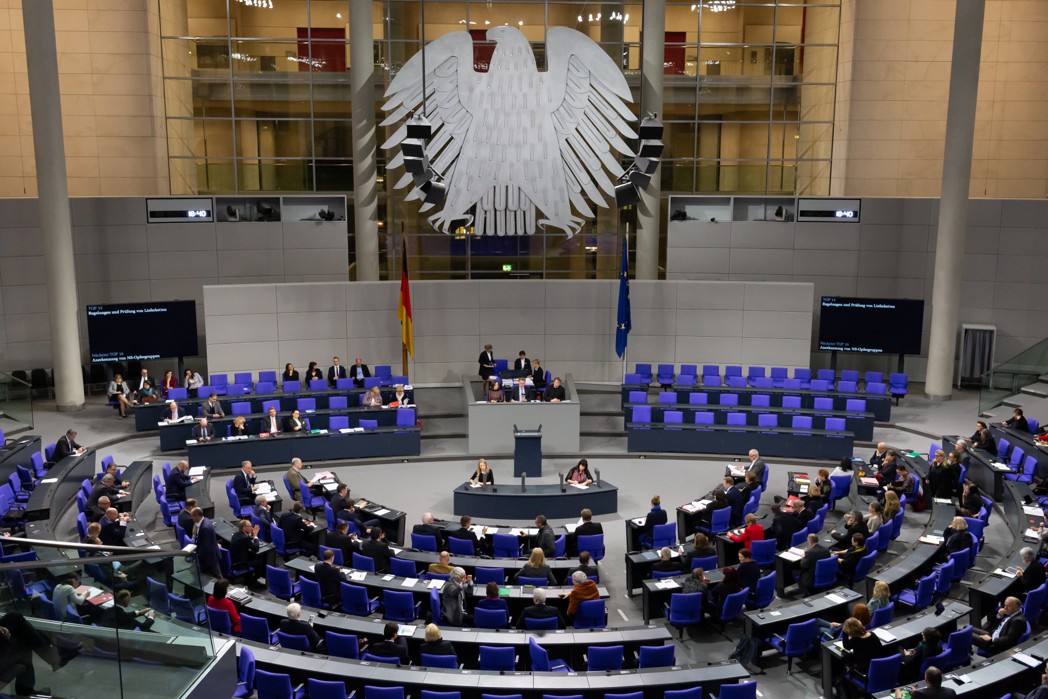
Credits: Steffen Prößdorf published on Wikimedia Commons
Introduction
Can constitutional law protect future generations from the consequences of today’s climate inaction? The legal and policy developments in Germany following the pivotal case of Neubauer v. Germany suggests that it can, but that legal victories are often not enough to secure lasting and meaningful climate policies: The long-term success of such legal victories depends on a continuous effort against legislative backsliding. This piece examines the Neubauer case, its victories, and how the struggle to translate its ruling into meaningful environmental policy continues today.
The Court’s decisions: A definitive step towards climate justice
The Neubauer case began in 2020, when a group of youth activists brought a case before the German Federal Constitutional Court challenging Germany's Federal Climate Protection Act (better known as the KSG,) by claiming it was incompatible with their fundamental rights. Adopted in 2019, the KSG mandated that Germany should reduce its greenhouse gas emissions by 55% by 2030, but set no reduction targets beyond this date. The plaintiffs challenged the KSG’s insufficiencies by arguing that its current targets unfairly postponed necessary mitigation efforts and thus offloaded the burden of emissions reductions onto future generations. As such, the plaintiffs claimed this would violate their rights under Germany's Basic Law, as well as under Germany’s commitments to the Paris Agreement. In a pivotal and unexpected ruling, the Court agreed. In April of 2021, the Federal Constitutional Court published a decision that denounced the KSG as partially unconstitutional and established that the state has a duty to distribute its carbon budget equitably across generations.
One of the most important parts of the ruling was that for the first time, the Court introduced the concept of fundamental rights as “intertemporal guarantees of freedom” (paragraph 122). It was ruled that these guarantees compel the state not to offload the burden of CO2 emission reductions onto future generations, as doing so would force future citizens into “radical abstinence” and a loss of freedom (paragraph 193). This part of the ruling broke new ground by giving citizens a constitutional foothold to demand stricter climate policies. Finally, future generations had a legal standing rooted in constitutional rights rather than simple political goodwill.
In response to the ruling, the KSG was updated in August of 2021; its new targets include a 65% reduction of GHG emissions by 2030 and achieving carbon neutrality in Germany by 2045.
Aftermath: Lasting impact and challenges
The Neubauer case is seen as a landmark decision that reinterpreted the state’s obligation to protect the environment and the rights of future generations. Beyond Germany, the ruling has been described as “historic” in the field of climate litigation; that it strengthened the role of constitutional rights, providing a legal precedent for climate cases worldwide. However, the Neubauer ruling was not without substantial criticisms. A core objection was the ruling’s ambiguity, and the widespread disagreements on how the Court’s decisions should be implemented in practice. Critics argue that the ruling did not clearly define how Germany’s “fair share” of the global carbon budget should be calculated; it didn’t set its own emissions targets or prescribe specific policies, leaving the government wide discretion in how to respond.
This discretion, it turns out, had significant consequences. Rather than prompting the government to develop more rigorous climate polices, the flexibility of the Court may have created room for legislative backsliding. Yet this causal link is not straightforward. A more prescriptive ruling that dictated specific policies might have equally provoked accusations of judicial overreach or “juristocracy.” Lasting climate policy ultimately requires political will, and a ruling perceived as overstepping that could have garnered even stronger opposition. Yet whether or not the Court’s flexibility was intentional, it had significant consequences in practice. In 2024, the German government passed an amendment to the KSG that abolished annual sector-specific targets, which are specific limits to greenhouse gas emissions set for individual industries like transport and infrastructure. Under the new amendment, if one sector fails to meet its goals, the shortfall can be “offset” by over-performance in other sectors. NGOs like Germanwatch and Deutsche Umwelthilfe have denounced this as a “slap in the face” to future generations. This amendment has itself become the subject of new and ongoing legal proceedings, directly invoking the principles established in the Neubauer case. In June 2024, five German environmental organisations announced they would file a series of new constitutional complaints against the federal government's climate policy and the new amendments to the KSG. These proceedings were joined by over 54,000 individual plaintiffs, including Luisa Neubauer and other key members of the original Neubauer campaign. Together, these plaintiffs argue that by abolishing binding sector targets, the government is again offloading the hard work of reform to future generations. Beyond just the amendments themselves, the complainants attacked the government’s broader failures to meet current sectoral emission targets, and its inaction in implementing meaningful reforms.
Conclusion: Why climate accountability doesn’t end in court
In the aftermath of Neubauer, many felt that Germany had turned a page towards a better, fairer future for the climate. However, this sense of progress proved difficult to sustain in the face of continued legislative resistance and a lack of future-oriented environmental policies. The vagueness of the Court’s ruling was met with a degree of political unwillingness to honour its principles. While the Court established a powerful legal framework by recognizing intertemporal guarantees of freedom, the Neubauer case is best understood as a milestone rather than a finish line. As shown by the ongoing legal challenges to the 2024 KSG amendments, constitutional victories do not automatically translate into strong climate policies. There is good reason why tens of thousands of plaintiffs have already rallied behind the new constitutional complaints against the KSG. For ordinary citizens, as well as for countries watching Germany’s example, Neubauer is proof that court rulings are only as durable as the civil society pressure that continues to support them. The work of preventing legislative backsliding is never complete, and Neubauer's legacy depends on the sustained political commitment and legislative will that future generations both deserve and depend upon.
Bio
Giorgia Urari is a second-year student at Leiden University College majoring in Governance, Economics and Development. This post was written as a continuation of a research clinic on “Climate Litigation for Future Generations” directed by Dr. Otto Spijkers.