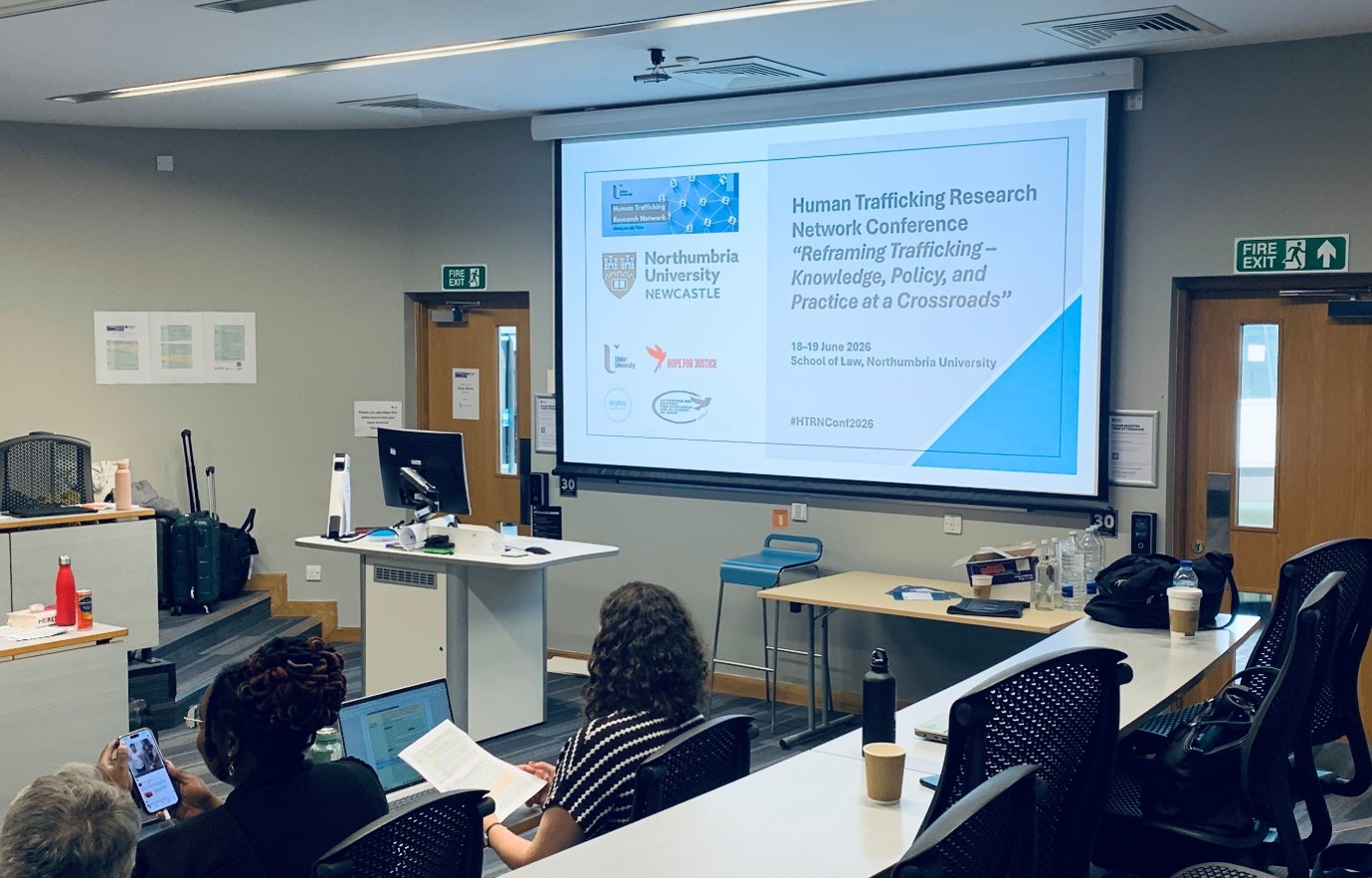
Credits: Hye-min Kim
This blog contribution draws on the 5th Human Trafficking Research Network (HTRN) Conference, held on 18-19 June 2026 at Northumbria University in the United Kingdom. Attendance was facilitated by a generous Conference Attendance Grant from the Netherlands Network of Human Rights Research (NNHRR).
The Human Trafficking Research Network (hereafter: HTRN) is a multidisciplinary community of academics and practitioners engaged in human trafficking-related research. Its fifth annual conference, themed ‘Reframing Trafficking – Knowledge, Policy, and Practice at a Crossroads’, fostered a profound exchange of knowledge across diverse regional, theoretical and methodological perspectives, reassessing the evolving global anti-trafficking landscape to better govern contemporary patterns of human trafficking and slavery.
Survivors as Experts with Lived Experience
The Conference featured two keynote speeches illustrating the two pillars of the global anti-trafficking ecosystem: the international/institutional, and the local/practical. The first keynote – delivered by Dr Katarina Schwarz, UN Special Rapporteur on Contemporary Forms of Slavery and Trafficking in Persons – mapped the centennial development of international law against slavery and human trafficking. Tracing history from the 1926 Slavery Convention to the milestone 2000 Palermo Protocol, she emphasised that this progress has been ‘hard-fought for and won’, and must never be taken for granted.
The second keynote was delivered by Jane Lasonder, Chair of the Hope for Justice Survivor Leadership Council and the International Survivors of Trafficking Advisory Council. Sharing her personal experiences as a survivor and practitioner, she demonstrated how lived experience culminates in genuine expertise that consolidates the anti-trafficking movement. This approach champions victim-centric reparation in the strongest possible way: giving voice to survivors and empowering them as leading experts in the field, rather than treating them merely as passive, stigmatised victims to be repaired.
Both keynotes emphasised survivor-centricity and a holistic approach, advocating that survivors’ lived experience must be included in the anti-trafficking system and recognised as firsthand expertise. Consequently, survivors deserve just treatment as experts in terms of organisational position and remuneration. The speakers also stressed that institutions, practitioners and researchers at the international, regional and local levels must work together, not in parallel.
Panel discussions further illustrated trafficking’s complex prevalence across regions, encompassing issues from environmental change and digital technologies to conflict and displacement, affecting vulnerable groups like refugees, women and children. One critical observation raised during the discussions – especially regarding the Chilean context – was that legally undefined core concepts related to human trafficking, such as exploitation, perpetrators or victims, increase reliance on the judicial discretion of individual domestic judges, which can ultimately undermine criminal justice and victim protection. This vulnerability is especially acute in ‘grey zones’ where a former victim of exploitation is forcefully coerced into becoming a perpetrator, such as child criminal exploitation. To resolve this conceptual gap, the author highlights that applying the internationally recognised ‘non-punishment principle’ – which holds that victims should not be prosecuted for unlawful acts committed under compulsion – is critical here. Overcoming this binary victim-perpetrator identification is thus essential to systemically combating complex human trafficking networks.
Reframing Reparation: Bypassing Proportionality through Solidary Obligation
The conference wrapped up with a Law and Policy Roundtable, where the author presented key insights from her ongoing doctoral research in a presentation titled, ‘Transnational Trafficking and the Trace-Back Impasse in Reparation: Bypassing Proportionality through Solidary Obligation (revised)’.
In line with the conference theme, the author introduced a novel doctrinal analysis of the obligation to make reparation when plural States contribute to the causation of human rights harms. Using a ‘trace-back’ analysis, this research diagnoses the ‘trace-back impasse’ – a mechanism gap where the existing reparation regime cannot operationalise a victim’s substantive right to full reparation due to causal complexity, where relative causal uncertainty is implied (see ILC ARSIWA Commentaries to Articles 31, paras 5-7, 12, 14 and 47, paras 1-3, 9).
Human trafficking is often built on the concurrent, indispensable failures of plural States – meaning more than one State contributing to the situation. For instance, in the Rantsev case, although the European Court of Human Rights found the respondent States – Cyprus and Russia – responsible, the adjudication process faltered at the reparative phase. Faced with the indivisible suffering of the victim – trafficking, exploitation and death – the Court could not mathematically apportion each State’s relative contribution, even though both were indispensable in causing the harm. The Court instead severed the causal chain, confining the responsibility strictly to the trafficking segment (see Rantsev, paras 222, 223, 242 and 308). It thus fragmented the reparation, ordering Cyprus (for its substantive violation under Article 4 of the European Convention on Human Rights, the prohibition of slavery and forced labour) to pay twenty times as much as Russia (for its procedural violation under the same article), leaving the central harm – the loss of life – legally unaddressed and thus unredressed (see Rantsev, Operative Provisions, points 8 and 10).
This limitation stems from the traditional reparation framework’s bilateral, State-centric logic, which relies on a proportional slicing mechanism (the principle of proportionality) based on a State’s relative contribution (see ILC ARSIWA Commentary to Article 31, para 14). However, when plural States make indispensable contributions to an indivisible human rights harm, their relative causal shares are rendered mathematically unapportionable. This proportionality metric then becomes structurally inoperable, creating what the author’s research diagnoses as the trace-back impasse.
To resolve this mechanism gap, the author’s research shifts the anchor of reparative obligation from State contribution to the victim’s harm, integrating ‘solidary obligation’ – a concept akin to joint and several liability, allowing victims to claim the entirety of their compensation or debt from any fully responsible co-authoring State or co-debtors – as a damage-based, victim-centric secondary principle of reparation under international human rights law. When the unitary narrative of suffering is ascribable to the indispensable contribution of plural States, the victim must not bear the evidentiary risk of apportioning the unapportionable to pursue full reparation. Instead, the risk of relative causal uncertainty must be shifted back onto the wrongful States, where it belongs.
The priority is securing the victim’s substantive right to reparation. Under the principle of solidary obligation, allowing them to claim full reparation from any indispensable contributing State crystallises the unitary legal damage into a solidary reparative debt owed to the victim. This is the ultimate ‘reframing’ achieved through this legal analysis, which re-envisions the international legal framework of reparation to ensure transnational human trafficking survivors the holistic reparation they are owed.
Conclusion
As a public international law researcher, the author found the HTRN Conference a profound learning experience. Engaging with policy researchers, frontline practitioners, and survivors with lived experience confirmed that such legal scholarship fulfils its ultimate effet utile when it serves as a consolidated, pro homine foundation that can be confidently utilised by those fighting on the front lines.
It was a humbling experience, a reminder that although rigorous doctrinal logic and legal interpretation are developed at the desk, as a human rights legal researcher, the feet must always remain on the ground, with the eyes on the rights-holders and victims.
Bio

Hye-min Kim is a PhD candidate at the Netherlands Institute of Human Rights (SIM), Utrecht University, specialising in international human rights law and the law of State responsibility. Her work focuses on reparative mechanisms in contexts of relative causal uncertainty of plural States, advancing a rigorous doctrinal inquiry to crystallise and operationalise the principle of ‘solidary obligation to make reparation’ as a damage-based, victim-centric standard of reparation under international human rights law. She completed an LL.M. (with merit) in International Human Rights Law at the University of Essex, the United Kingdom and an M.A. in International Affairs at the Graduate Institute of International and Development Studies (IHEID), Geneva, Switzerland.