Credits: Antonella Patteri
Introduction
The path towards the implementation of the European Union Pact on Migration and Asylum (hereinafter the Pact) by Member States has been long and winding. Introduced in 2020 by the European Commission’s proposal, it promised new rules to both manage migration and establish a common asylum system at EU level. However, after a lengthy and, at times, contested legislative process, the final legislative package - adopted in May 2024 and becoming applicable as of today - heavily focusses on asylum over migration, as evidenced by all key instruments in the Pact.
The result is to be lamented, as the Pact was an opportunity to build on the EU’s core constitutional values of respect for human dignity, freedom, democracy, equality, the rule of law, and of respect for human rights; by creating safe legal pathways, enhancing the integration of non-EU citizens, and recognising the significant contribution third-country nationals make to European society and economy. Instead, the underlying message of the Pact is that the EU is to be further fortified against unwanted influxes of people on the move who pose a risk or a threat to “our European way of life”. It seems that the resonance of such a message will continue to be amplified in the current political context, thus requiring continued critical reflection on how migration can be better managed, using academic rigour and insights from strong evidence-based research.
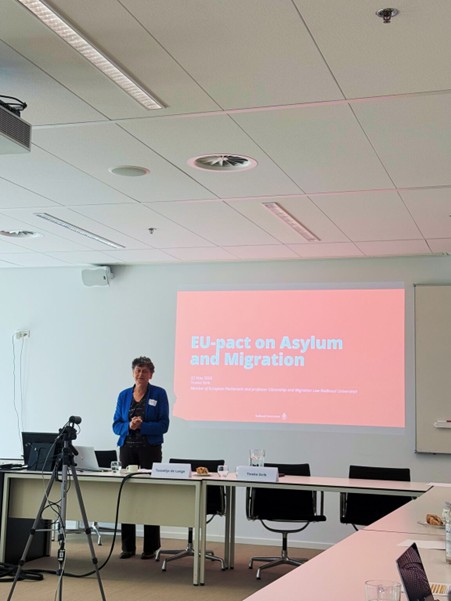
On Friday 22 May 2026, researchers from across Europe – and beyond – gathered to discuss the implications of the Pact on the future of asylum and migration law in the EU. Hosted by Radboud University’s Centre for Migration Law, and co-organised with the KU Leuven Institute for European Law and the Amsterdam Centre for Constitutional Culture & Democratic Governance (UvA), the participants of the one-day workshop pondered the question: “The Promise of the Pact? What the EU promised but the Pact on Migration and Asylum does not deliver”.
The broken promise of harmonisation and the fundamental rights fall-out
In her keynote, Tineke Strik, Professor of Citizenship and Migration Law and Member of the European Parliament, presented the state of the art in relation to the Pact’s legal instruments. This included those legal instruments still subject to the legislative process such as the recently adopted Return Regulation, and the proposals for the facilitation packages and the Frontex Regulation, and amendments to concepts such as the safe third country. The key message from this overview reveals the biggest “promise” to have been broken: the stated aim of greater harmonisation and clarification on asylum rules and procedures. Instead, the Pact’s stance runs the risk of an ever-fragmented response by Member States.
The implications of this are particularly grave, given – as Professor Strik highlighted – the continued tendency towards state practices that violate the fundamental rights of those seeking international protection. For instance, pushbacks that violate the principle of non-refoulement (a topic of a multitude of cases before the European Court of Human Rights) and the provision of reception conditions that amount to inhuman and degrading treatment (for instance in Belgium and Greece).
Critically, the role of EU agencies in facilitating violations of fundamental rights is not to be overlooked – as confirmed by two judgments delivered by the Grand Chamber of the Court of Justice of the European Union in December 2025, where the Court held Frontex liable for human rights violations: in the case of WS and Others v. Frontex (C-679/23 P), the illegal pushback of a Syrian family from Greece to Turkey, before they had the chance to apply for asylum; and in Hamoudi v. Frontex (C‑136/24 P) where the applicant – a Syrian national – was sent back out to sea after being disembarked upon the Greek island of Samos.
A common theme across the four panels that comprised the remainder of the workshop was the fragmentation and diversity of approaches amongst Member States when the Pact is implemented in national legal systems across the EU. This fragmentation materialises for instance in Member States’ ability to conclude bilateral agreements with third countries (Tamta Gventadze, University of Tuscia and Marion Panizzon, University of Bern), in the political discretion of the Member States rendering the solidarity system ineffective (Konstantina Liontou, Democritus University of Thrace), the ways in which the Member States have anticipated the implementation of the Pact before it became applicable (Greta Albertari, VU Amsterdam) and in the remaining possibility for different procedural regimes across Member States (Ramón Barreto, Oslo Metropolitan University).
A total of 19 presentations on topics related to solidarity and asylum, vulnerability, legal pathways, and international partnerships with third countries, provided a snapshot of where we stand on the eve of the Pact’s application.
From promises to gaps: What the Pact overlooked
From these presentations, two fils rouges merit a slightly more in-depth focus on what follows. Crucially, whilst the workshop placed an emphasis on the broken promises of the Pact, i.e. the issues that the EU Pact does not address, but which the EU legislator promised to solve, the presentations also revealed another very important perspective: what the Pact overlooked! This will be illustrated with the following two examples.
First, the Interoperabilty of the Pact: The scope of the Pact’s key legislative and policy developments remains firmly situated within the EU migration and asylum acquis. However, the necessity to engage with other areas of EU law, including fundamental rights law, was very strongly communicated during the workshop.
A particular area of concern that has emerged in parallel to the EU Pact on Migration and Asylum is the increased digitalisation and use of information and communication technology to facilitate the asylum and border procedures. The “big data” approach to asylum has, nevertheless, a significant impact on certain vulnerable groups and requires an interoperable understanding of EU migration and asylum law with “new laws” such as the Artificial Intelligence Act and “old laws” such as well-established legal standards in relation to the rights of the child (Mark Klaassen, Leiden University). For instance, the datafication of childhood (Murtaza Mohiqi, University of Agder & Gagandeep Kaur, UPES) and the increased use of predictive algorithms (Leyla Gayibova, VU Amsterdam) could overlook the necessary fundamental rights protections that are required in relation to protection of personal data and the best interests of the child.
Second, the Anticipatory Turn of the Pact: A number of papers underlined the anticipatory turn that the Pact has fostered, with an increased emphasis on predicting the risk of (large scale) migration flows (Gayibova) and control (Martin Westlund, University of Gothenburg; Pedro Sanz Diaz, Dublin City University). Similarly, despite positing the anticipatory nature of humanitarian responses to forced displacement, the Pact fails to make a meaningful contribution given the dissatisfactory result of a weak resettlement framework (Meltem Ineli Ciger, Suleyman Demirel University; Caroline Leclerq, University libre de Bruxelles), which does not create the complementary pathways that are needed for refugees (Emiliya Bratanova, Lund University). Also, the lack of attention for integrating labour pathways, like those based on the Single Permit Directive, in the Pact is a missed opportunity (Marco Paron Trivellato, Université Libre Bruxelles).
Beyond the Pact: Concluding remarks
One of the main driving forces behind the Pact’s conceptualisation was the 2015 large influx of people on the move and its impact on the operationalisation of the EU asylum and borders procedure. Given the protracted nature of the Pact’s development, as noted in the Introduction, a key emerging remark from the workshop merits brief attention: To what extent is the Pact still fit for purpose? Tineke Strik cautioned against the shift beyond the Pact, with the focus on migration deals with third-countries (such as Egypt, Tunisia and Türkiye) in relation to prevention and return, wherein fundamental rights safeguards are completely absent, leading to a repressive externalised policy to asylum management. In this vein, presenters noted that the architecture of the Pact’s new rules on asylum – and return (Jonas Bornemann, University of Groningen) – mean that the protection of fundamental rights and guarantees for integration (Matteo Bottero, University of Copenhagen) have been overridden or outsourced (Barreto; Irmak Kurtulmuş, Toronto Metropolitan University). Notwithstanding, continued and effective fundamental rights monitoring must be assured to guarantee accountability and enforcement of fundamental rights safeguards (Antonella Patteri, Polish Academy of Sciences; Salvo Nicolosi, Utrecht University).
Acknowledgements: The organisers would like to thank the Netherlands Network for Human Rights (NNHRR) and the NNHRR Migration and Borders Working Group for the generous financial support that facilitated the realisation of the workshop.
Bios

Dr. Karen Geertsema is assistant professor of Migration Law at the Centre for Migration Law of the Radboud University. Her research focuses on the role of the judiciary in migration law and the effects of international and European law on national procedural laws. Besides her academic work she is substitute judge at the District Court of Overijssel. Currently she trains Dutch judges and lawyers on the EU-Pact on Migration and Asylum.

Dr. Lynn Hillary is an assistant professor of Constitutional and Administrative Law at the Amsterdam Centre for Constitutional Culture & Democratic Governance (ACCu) of the University of Amsterdam. Her research focuses on the interaction between EU law, refugee law, and human rights.

Dr. Annick Pijnenburg is an assistant professor in International and European Law at the Research Centre for State and Law (SteR) and department of International and European Law at Radboud University Nijmegen. Her research focuses on international human rights law and migration, focusing especially on the externalisation of migration control and asylum.

Dr. Amy Weatherburn is FWO Senior Postdoctoral Fellow at the KU Leuven Institute for European Law with expertise in human trafficking, forced labour, (labour) migration and fundamental rights law. Following publication of her monograph Labour Exploitation in Human Trafficking Law (Intersentia, 2021), her current research focuses on tackling labour exploitation beyond criminal law and providing access to remedy to migrant workers.
Dr. Karin Zwaan is an associate professor in Migration Law at Radboud University Nijmegen. She has a background in constitutional and administrative law, with a strong focus on migration law. Her expertise focuses on refugee status determination, and the use of evidence in migration cases. She has published widely on international, European & Dutch migration law.