Credits: Silvia Ciacchi
This blogpost draws upon the 14th United Nations Forum on Business and Human Rights (24–26 November 2025), entitled “Accelerating action on business and human rights amidst crises and transformations.” This event aimed to provide a multi-stakeholder platform to assess progress in implementing the UN Guiding Principles on Business and Human Rights (UNGPs) and explore how States, businesses and other actors can accelerate action amidst interlocking global crises and transformations. The author’s conference attendance was facilitated by a conference attendance grant from the Netherlands Network of Human Rights Research (NNHRR).
Introduction
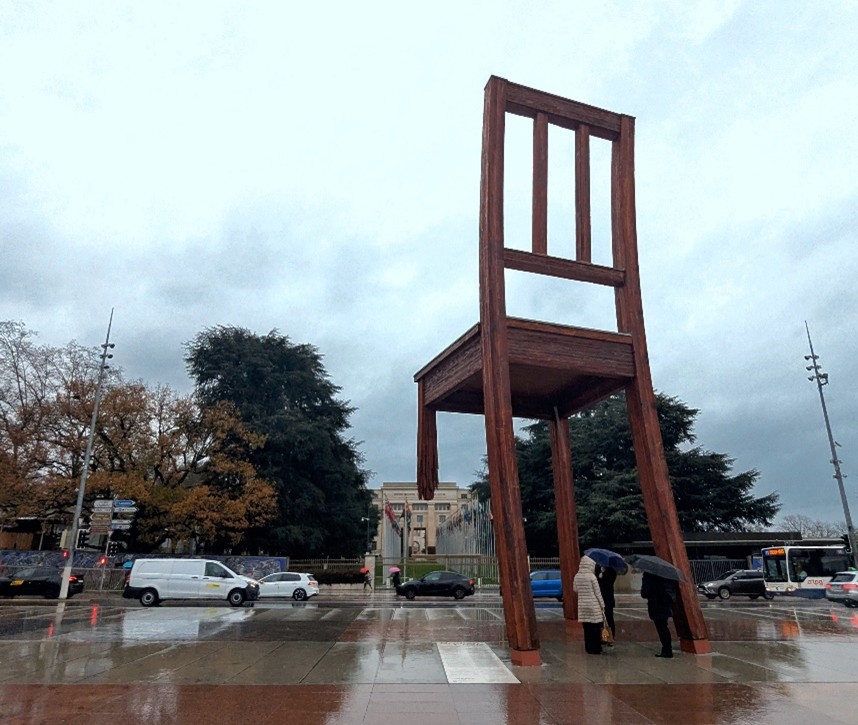
In the early morning of November 24th 2025, the cold air and rainy streets of Geneva welcomed the participants gathering for the first day of the 14th United Nations (UN) Forum on Business and Human Rights (BHR). At the Palais des Nations, familiar faces met in unfamiliar spaces, as the usual rooms had been reassigned due to ongoing renovations. In front of the building stood the Broken Chair, a symbol of the violence of war and human fragility, but also the stability and resilience we must cling to in violent times. Striking against the wind and rain during the 14th UN BHR Forum, the artwork perhaps inspired new meaning in the minds of attendees. In a way, much like the temporary nature of the venues themselves, it seemed evocative of an event marked by the need to adapt and find one’s footing in an uncertain moment.
Every year, the Forum brings together policymakers, academics, business representatives and civil society to foster dialogue around a shared purpose. Thousands of participants gather from governments, businesses, civil society organisations, academic institutions and all kinds of stakeholders. This year, the 14th rendition of the Forum set against a global landscape marked by instability, conflict and a mounting loss of trust in the ability of national and international institutions alike to truly protect, advocate for and prioritise human rights in the face of powerful challenges to their intrinsic value. This context is perhaps what made it such a unique and insightful experience.
A Forum at the Time of the Polycrisis
The Opening Plenary voiced many of the undertones already hanging heavy in the air. The polycrisis – i.e. the convergence of interlinked crises, including the triple planetary crises of climate change, biodiversity loss and pollution, armed conflicts, financial instability, and the unregulated development of new technologies such as AI – was mentioned several times, capturing the multi-level challenges of the BHR landscape. The complicity of businesses in war crimes; the rise of tech giants and the loss of grip on information, privacy and personal data; the continued exploitation of migrant workers and the embedded inequalities of global value chains; the centralisation of power in the hands of few; the erosion of political will for human rights protection and the increasing reactionary tone of public discourse.
The High Commissioner for Human Rights, Volker Türk, describing his office as being “on its knees” and scraping for survival, painted perhaps the most vivid picture of the depth of the crisis facing the business and human rights community. And, indeed, several calls were made throughout the three days for voluntary donations in light of the heavy toll of funding cuts. The High Commissioner’s words are a candid and powerful illustration of current times. On one side of the Atlantic, the United States has embraced an openly dismissive rhetoric toward international human rights and is backing it up by withholding its contributions to the UN. On the other, the European Union has shown the world that even long‑standing champions of human rights and sustainability will retreat in the face of enough economic and political pressure, no matter the loss of credibility and legitimacy.
Despite the sense of powerlessness, though - and perhaps paradoxically - attending this year’s event made clear that moments like these may be exactly when the Forum is most needed.
Across the Forum, the sessions spanned many themes. From the importance of people-centred due diligence and the centrality of credible information and partnerships to carry out due diligence in conflict-affected contexts; to the importance of strengthening mandatory HRDD to implementation gaps and enforcement in emerging laws and the need to develop transformative development models that can fully realise human rights, sustainability and economic justice, and many more.
When listening to the rich and diverse conversations, my thoughts were on the throughlines. What insights will we really bring home from this year’s event?
Power and The Status Quo
A pointed question was raised in one of the sessions: “we have all of this knowledge, these frameworks and tools. We know what’s important, and we have all the resources on how to tackle the major problems of our time. Why, then, are things not changing?”
In my view, the answer goes to a deeper issue that also surfaced in several of the Forum’s conversations: power. This theme emerged as a throughline both explicitly and implicitly, as several of the discussions ensuing from the panels highlighted the difficulties in holding decisionmakers to account and driving them towards meaningful change. A dimension further underscored by the context of withdrawn support and funding for business and human rights-related initiatives. Who really has the power to change things, and who does not? Who gains from the current structures, and who bears the costs? And what, realistically, can be done to shift the power dynamics that create entrenched patterns of harm?
Questions like these and the one reported above, highlight a perhaps too often unspoken truth at the heart of the business and human rights field: the status quo is harmful, and harm is profitable. Exploiting - and failing to protect human rights - saves costs. Enormously so. The prevailing business models and the global economic system ultimately fail to attach value to well-being and to fundamental rights and freedoms. Therefore, the way that value is measured and pursued systematically incentivises cost-optimisation in the way of abuse and exploitation.
Accordingly, there are powerful interests with everything to gain from the systemic, ongoing perpetuation of human rights (and environmental) abuses. While it is certainly possible for businesses to operate in ways that are both compatible with human rights and economically successful, the actors that hold the power to enact the systemic changes required to enable this compatibility, have no real interest in listening, changing or coordinating towards this purpose. This is the case for governments, corporate giants and the individuals in positions power within these systems. Where there is power, there is often no will; and where there is will, there is often little power.
This heavy realisation also raises questions of perspective, which were echoed in the Forum. Yes, finding ways to operationalise BHR within the current system is important. But the conversation must also be about systemic issues and systemic change. How can we reach genuine structural reform of the economic system? How can power structures be challenged, and how can power be channelled in a new direction?
Putting Rightsholders at the Centre
A strong theme throughout the Forum was the necessity of centring rightsholders - not only as passive victims but as active agents and sources of solutions. Many panels stressed the importance of listening to Global South perspectives and elevating local expertise. Admittedly, only a few sessions truly did so. But when they did, it was powerful. The Development Dialogues offered one of the most striking moments of the Forum through the testimony of Moe Turaga, a survivor of modern slavery in Australia. His moving intervention grounded the discussion and really set the tone for the conversation that followed. There is something to say about bringing humanity back at the centre of the conversation. And, perhaps, speaking empathy to power is something that we can tangibly do to build momentum and close the distance between abstract thought and lived experience.
The Anchoring Role of Academia
A hopeful moment came from an event held during the first day of the Forum marking the 10th anniversary of the Business and Human Rights Journal, which centred the session around passing the torch to a new editorial team and spotlighting emerging voices. Even amidst these times of crisis, the fact that BHR is now an established field and a growing scholarly community continuing to expand and diversify, is something to celebrate. It is also a reminder that academia has the privilege of continuity. Even when political climates shift, scholars can keep building the knowledge base that may become actionable later on.
Silver Linings
Attending the Forum was valuable precisely because it showed the resilience of a community in times of crisis: listening, adapting, collaborating, and keeping the right conversations alive. It is perhaps in moments like these that events such as the Forum become most important. When political will thins, trust erodes, and conditions materially worsen, the only thing we can do is hold onto shared values, reinforce their importance, and keep working on solutions. Plus, in events like this, the conversations in the side rooms, forming initiatives, starting projects, forging collaborations, are just as important as the panels and the presentations. And perhaps the outcomes of these moments are another thing to look forward to in times to come. All in all, what the 14th UN BHR Forum showed, is a community that keeps the spark alive.

Bio:
Silvia Ciacchi is a PhD candidate in Law and Economics at Erasmus University Rotterdam and coordinator of the Business and Human Rights Working Group of the Netherlands Network of Human Rights Research (NNHRR). Her research explores corporate sustainability regulation, human rights due diligence, and the governance of global value chains.